
There is a kind of knowing that does not come from thinking. It rises from somewhere lower in the body, from the gut or the chest or some unnamed space behind the sternum, and it arrives as a felt certainty rather than a reasoned conclusion. You may have been taught not to trust it. You may have learned to override it with logic, with practicality, with the preferences of people whose approval felt necessary. And yet it keeps returning. Water element rituals begins not with technique, but with permission: permission to feel what you already feel, to let the body's deeper intelligence into the conversation without demanding that it first justify or prove itself.
What Water Feels Like in the Body
Water is the element of tidal movement. Emotion, when Water is flowing freely, moves like a wave: it builds, reaches its fullness, moves through you, and recedes. The body, after a good cry or a long release, feels wrung out in the best possible way: emptied and available. When Water is blocked, emotion pools and grows stagnant. You may find yourself carrying a dull heaviness you cannot trace to any particular event, a thickness in the throat, a pressure behind the eyes that never quite releases. Or Water in excess spills its banks: you are flooded by feeling before you can find solid ground.
The gut-knowing of intuition is also Water's gift. Many somatic practitioners describe the body's second brain, the enteric nervous system woven through the gut lining, as a site of pre-cognitive knowing. The felt sense of "yes" or "no" that precedes conscious deliberation often speaks in Water's language: a settling or a tightening, a warmth or a cold clarity.
Water in Astrology: Cancer, Scorpio, and Pisces
The three Water signs share a quality of depth, though each dives differently. Cancer is the element in its most nurturing and protective expression: the crab carries its home on its back, holds its tender interior behind a hard shell, and moves sideways when a direct approach feels too exposing. Scorpio dives deeper still, into the hidden currents beneath the surface: transformation, power, the parts of psyche that most people prefer not to examine. Pisces moves in all directions at once, porous and dreaming, the sign most likely to absorb the emotional weather of an entire room without knowing whose feelings are whose.
Whatever your Sun sign, everyone carries Water somewhere in their chart. If you are curious about your own elemental makeup, a chart reading with an astrologer can illuminate which element is most active, which is less developed, and what the current season of your life is asking for. The elemental astrology birth chart guide offers a useful orientation to reading your own chart through this lens.
Working with Water: Core Ritual Orientations
Water responds to permission, gentleness, and witness. These are not passive qualities. Choosing to feel something fully, rather than managing it, is a form of active engagement. Working with Water in ritual often means slowing down enough to notice what is already moving beneath the surface.
Some foundational orientations:
- Receptivity over performance. Fire rituals build. Earth rituals ground. Water rituals receive. You are not trying to produce an outcome. You are making space for what is already present to be felt.
- The body as oracle. In Water-aligned practice, physical sensation is information. Tightness, ease, heat, cold, the direction your attention keeps returning to: these are not distractions from the ritual. They are the ritual.
- Fluid structure. Water does not conform to rigid containers. Practices that build in softness, that allow the work to go where it needs to go rather than where you planned, tend to be more alive.

Ritual Practices for Water Element
The Tidal Breath
Sit or lie down in a position that allows the belly to move freely. Place one hand there. Breathe in slowly, feeling the belly rise. Hold very briefly at the top. Exhale slowly, longer than the inhale, feeling the belly fall. Pause at the bottom before the next breath begins. This pause, that moment of emptiness before the new breath arrives, is the tidal moment Water most wants you to notice. Stay with it. Let it be a little longer than is comfortable.
Practice this for five to ten minutes. You may find emotions rising. Let them. The tidal breath is not a technique for staying calm; it is a technique for staying present while the wave moves through.
Emotion Mapping with the Body Scan
This practice is useful when you are carrying something unnamed. Lie down and close your eyes. Beginning at the crown of the head and moving slowly downward, pause at each area of the body and ask: what is here? Not what should be here, or what you wish were here. What is actually present? You may find areas of numbness, of warmth, of tightness, of unexpected ease.
When you encounter something, stay with it. Breathe into it. Give it a quality: weight, temperature, texture, color. This is not analysis. You are not trying to understand the feeling intellectually. You are making contact with it, which is often enough to begin its movement.
The Mirror Practice
This one asks something specific of you. Sit before a mirror, close enough to see your own eyes clearly. Set a timer for five minutes. Look at your own face without agenda. You will want to look away, to adjust something, to begin evaluating what you see. Try to stay. Let your face be whatever it is. After a few minutes, most people find that something softens. The habitual self-presentation drops slightly. What remains is something closer to actual feeling.
You can end this practice simply by placing a hand on your heart and saying something true aloud. Not something you are supposed to feel. Something you actually feel. The combination of your own eyes as witness and your own voice as truth-teller is more potent than it may sound.
Ritual Bathing
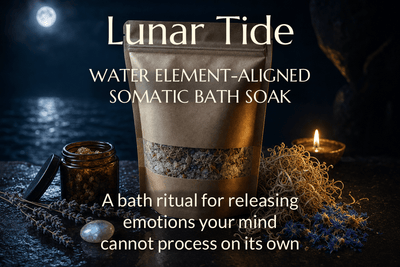
Water responds to intention. Before drawing a bath or standing in a shower, take thirty seconds to articulate what you are bringing into this practice. It might be exhaustion, grief, a decision you have been circling, a fear you are tired of carrying. Let the water be a second skin, a permeable boundary between the held and the released. You might add salts for purification, or a few drops of a Water-aligned oil (see below). You might stay longer than you think you need to. The body knows when it is ready to step out. That knowing is Water's.
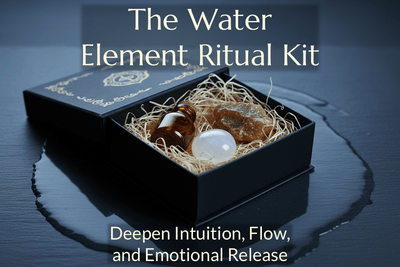
A bath soak that facilitates a deep experience with the water element or our water element kit may be very helpful to hold space for what needs to flow.
Dream Journaling
Water's connection to the unconscious makes dream work one of its most natural portals. Keep a notebook beside the bed. Before sleep, set an intention: I am open to what is ready to be seen. Upon waking, before reaching for a phone or speaking to anyone, write down whatever is present. Images, fragments, feelings, even the quality of the sleep itself. You are not trying to interpret the dreams. You are building a relationship with the part of you that speaks in images rather than sentences.
Over time, patterns emerge. You may find certain symbols returning, certain emotional tones that correlate with what is active in your waking life. This is the deep Water work: the slow accumulation of a more honest map of your own interior.
Botanicals, Aromatics, and Materia
Water-aligned plants tend to be cooling, moistening, or connected to actual water in their growing environments. They often carry a quality of softness or of opening.
Rose (Rosa) is perhaps the most universally Water-aligned botanical. Its relationship to the heart, to emotion, to the gentle opening of what has been held closed, makes it a natural companion for any Water work. In aromatherapy, rose otto or rose absolute can be used in ritual bathing, in a diffuser during emotional processing work, or applied (diluted in a carrier oil) over the heart center before a practice of self-witness.
Blue lotus (Nymphaea caerulea) has a long history in ceremonial and spiritual contexts as a plant that opens intuitive perception. It grows at the boundary of water and air, blooms and retreats with the light, and carries that quality of liminal knowing. It is available as a dried flower for tea, as a tincture, or as an extract.
Mugwort (Artemisia vulgaris) is a classic plant ally for dream work and lunar practice. Associated with the moon, with the feminine, and with the thin veil between waking and dreaming consciousness, mugwort tea taken before sleep, or a small sachet placed beneath the pillow, is a traditional practice for deepening dream recall and lucidity.
Marshmallow root (Althaea officinalis) works at the level of the body's own moistening: it soothes inflamed or dried-out mucous membranes and has a gentle, demulcent quality that mirrors the emotional work of Water at the physical level. In ritual context, it can be taken as a tea during practices of emotional release, supporting the body's capacity to move grief through the tissues.
Yarrow (Achillea millefolium) at first seems contradictory for a Water practice, since it is a plant of boundaries and protection. But for those whose Water is excessive, who absorb too much of others' emotional weather, who lose themselves in feeling, yarrow offers what Water most needs when it is overflowing: a container. A few drops of yarrow flower essence, or yarrow tea taken before emotionally demanding situations, can help maintain the boundary between your feeling and everyone else's.
Ritual Objects and Environmental Cues
Water responds to the physical environment of practice. Some elements worth considering:
- Bowls of water on the altar, perhaps with a floating candle or a few petals, create a surface for reflection in both senses: the literal image and the internal one.
- Blue and silver tones, watery blues, and the deep near-black of still water at night create a visual environment that signals Water consciousness to the deeper mind.
- Sound is particularly important in Water work. Moving water (a recording of rain, a small fountain, ocean waves), or music that carries a watery quality, slow and oceanic in its movement, can drop the body into a more receptive state more efficiently than almost any other cue.
- Moonstone, aquamarine and labradorite are stones that many practitioners associate with Water and with intuitive work. Their value is in their capacity to serve as anchors for intention ; use them as objects of focus if they speak to you.
Integration: Living the Water Practices
Water work is not confined to the ritual space. The practices that build the most over time are the ones that become part of ordinary life: the breath you take before responding instead of reacting, the pause you give yourself before overriding an intuitive sense with rationalization, the small act of feeling something fully rather than managing it into silence.
Keeping a simple daily check-in, taking one minute each morning or evening to notice what you are actually feeling in your body, builds the Water capacity more reliably than occasional deep practices alone. The question is always the same: what is here? Not what should be here. What is.
If this framework resonates and you want to explore the other elements, the guides for Earth element rituals, Fire element rituals, and Air element rituals follow the same structure and can be used together or independently depending on what is alive for you right now.