
There is a particular moment that many people describe when they first look at their birth chart: a flicker of recognition, the sense that a pattern is being named that they have always known, but never had words for. If you have felt that, it is worth following. Your elemental signature birth chart is one of the most practically useful things astrology can offer, a specific, personal answer to a question most elemental introductions never quite get to: not just what the elements are, but which ones run most powerfully through you, which one you are quietly reaching toward, and what all of that might mean for how you practice.
This is not about reducing yourself to a single element or a single sign. The birth chart is a map of the whole sky at the moment you arrived, and the elements are distributed across it in proportions unique to you. Understanding those proportions is the beginning of personalized elemental practice. For a broader orientation to the four-element framework itself, the complete guide to four elements in ritual practice offers the full foundation.
Why Your Element Is Not Just Your Sun Sign
Most people who know a little astrology know their Sun sign and assume that determines their element. A Leo is fire, a Scorpio is water, a Capricorn is earth. True as far as it goes, but the Sun is only one of ten planetary placements, and in some charts it is not even the most influential placement.
Imagine two people with Aries Suns. One has a Pisces Moon, Cancer Rising, and three other planets in water. The other has a Sagittarius Moon, Leo Rising, and planets concentrated in fire and air. Both carry Aries fire at their core, but their elemental makeup is entirely different. Counting your placements across the whole chart produces something far more accurate than Sun sign alone.
How Elements Distribute Across the Zodiac
Each of the twelve zodiac signs belongs to one of the four elements, and this distribution is even across the wheel: three signs per element, each expressing the element's core quality in its own distinct way.
Fire Signs: Aries, Leo, Sagittarius
Fire signs share the quality of aliveness, the impulse to radiate outward, to initiate, to follow what inspires. Aries leads with courage and immediacy. Leo leads with warmth and the drive to be fully expressed. Sagittarius leads with the search for meaning and the hunger to understand the larger picture. Any planet placed in a fire sign carries that element's activating, forward-moving quality. To explore fire energy as a ritual practice, the guide to fire element activation rituals offers the full depth.
Earth Signs: Taurus, Virgo, Capricorn
Earth signs share the quality of groundedness, the impulse to build, tend, and make durable. Taurus leads through the body and the senses, through pleasure and loyal presence. Virgo leads through discernment and care, through the devotion to getting things right. Capricorn leads through patience and long vision, through the willingness to work across time. Any planet in an earth sign carries steadiness, practicality, and a deep relationship to the physical world. For the full exploration of earth as ritual practice, the guide to earth element grounding rituals is the place to begin.
Air Signs: Gemini, Libra, Aquarius
Air signs share the quality of circulation, the impulse to connect, exchange, and understand. Gemini leads through curiosity and the joy of exchange. Libra leads through the search for beauty, balance, and relational truth. Aquarius leads through the vision of what is possible at the level of the collective. Any planet in an air sign carries the quality of thought, communication, and the movement of ideas. For practices that work with air energy, the guide to air element clarity and communication rituals explores that territory.
Water Signs: Cancer, Scorpio, Pisces
Water signs share the quality of depth, the impulse to feel fully, to follow intuition, to tend what is hidden. Cancer leads through the tenderness of belonging and care. Scorpio leads through the willingness to descend into complexity and return transformed. Pisces leads through the dissolution of the boundary between self and everything else. Any planet in a water sign carries emotional intelligence, receptivity, and a close relationship to the unconscious. The complete guide to working with water element rituals and intuition offers the practices that support this element most directly.
The Three Most Important Placements
While all ten planetary placements carry elemental weight, three form the most visible layer of your elemental nature. Your Sun sign describes the element of your core identity. Your Moon sign describes the element of your emotional body and instinctive responses, where the nervous system defaults under pressure. Research on interoception, the process by which the nervous system senses and interprets the body's internal state, describes this same inner terrain in physiological terms: the moment-by-moment felt sense that shapes emotional life (Biological Psychiatry: CNNI). Many people find their Moon's element is what they are actually practicing when they tend to their well-being. Your Rising sign (the Ascendant) describes the element of your interface with the world, often the most visible in your presence.
To find these placements, you need your date, exact time, and place of birth. A free birth chart is available at lightfilled.co, one of the most reliable resources for accurate chart calculation.
Counting and Weighting Your Elemental Placements
Once you have your chart, count how many of your ten planetary placements fall in each element's signs, then apply a light leaning toward the personal planets. A useful approach: give two points to Sun, Moon, and Rising, and one point to each remaining planet. The element with the highest score is your dominant element; the lowest or absent one is your missing element. This is not a rigid formula, but it offers a clear, usable starting point. A more in-depth treatment of elemental weighting can be found through the astrological element analysis tools at astrotheme.com.

What the Numbers Are Telling You
A chart with six or more points in one element is considered a strong concentration: that element's qualities tend to be deeply available, often effortless, and sometimes so natural that the person cannot imagine experiencing the world without them. A chart with zero or one point in an element suggests that element's qualities are less instinctively accessible, though not absent. The soul, as one traditional framing holds, may have chosen this life precisely to develop what is not yet natural.
What It Means to Have a Dominant Element
A dominant element is a gift and a tendency. A strongly fire-dominant chart may move through life with a vitality and sense of purpose that others find inspiring, and also with a tendency to burn through rest in service of the next thing. A strongly earth-dominant chart may build things that last and feel at home in the body, and also occasionally confuse inertia with stability. Working with your dominant element means learning to draw on its gifts while staying awake to its tendencies, understanding your particular expression of vitality well enough to work with it wisely.
What It Means to Have a Missing or Minimal Element
A missing element is not a deficiency. It is more accurately described as an area of fascination and unconscious reaching. Many people with no water placements are deeply interested in emotional depth and intuitive knowing, precisely because water is not their native language. Many with no earth placements are quietly preoccupied with grounding and building something durable, not because they are bad at it, but because it requires conscious attention in ways it does not for a Taurus Sun.
The missing element is a doorway. It shows where your growth edge lives, and often where your deepest curiosity points. Some practitioners find that their most sustaining ritual work is with their missing element, not despite the difficulty, but because of the quality of attention it calls forth.
The Invitation of the Gap
Notice whether you are drawn to any particular element's rituals, aesthetics, or qualities in a way that feels like longing rather than familiarity. The element that you have always wanted more of, the one whose rituals feel both foreign and compelling, may be the one your practice is quietly asking you to explore. This is not a prescription. It is an invitation worth sitting with.
Working With Both Your Abundance and Your Gap
A complete elemental practice honors both dimensions: deepening your relationship to what comes naturally, and gently, courageously extending toward what does not.
Your dominant element is where you return when you are depleted or overwhelmed. It is the elemental equivalent of your mother tongue: the one you reach for when precision matters, when returning to yourself matters most. Your practices in your dominant element may feel restorative almost immediately, settling and familiar in the best sense.
Your missing element is where you stretch. The practices associated with it may feel slightly awkward at first, or activating in a way that is not entirely comfortable. This is not a sign that they are wrong for you. It may be a sign that they are working.
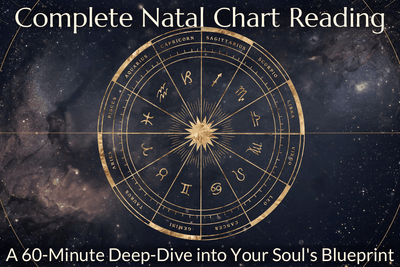
If you would like support in understanding how your specific elemental makeup maps onto a personalized ritual path, a complete natal chart reading offers exactly this kind of personalized elemental and astrological guidance. An astrology mini-reading is a shorter, more focused option for those who want to start with their elemental signature specifically.
You might also explore what a deeper astrological approach to your ritual life could look like through the astrology readings collection.
Your elemental signature is one thread of a larger chart; Astrology as a Ritual Map shows how to read the whole.
Your Elemental Signature as a Ritual Compass
Once you have a sense of your elemental makeup, even a rough one, you have something more useful than a personality type. You have a compass for your practice. When you are depleted and do not know what you need, check in with each element and notice which one feels most absent in your body. That is often your answer. When you are choosing a ritual, a product, or a practice, you can ask: is this working with my dominant element (coming home), or with my missing one (stretching toward medicine)? Both are valid. Both serve different moments.
The Sacred Ritual Kits collection offers elemental kits for each of the four elements, designed to support exactly this kind of intentional practice: both the deepening of what comes naturally and the reaching toward what calls from a distance.
Your elemental signature is not a fixed thing. Like the elements themselves, it is a living map, one that deepens in meaning the more you work with it. Begin with what is familiar. Let curiosity lead you to what is not yet familiar. The chart is not the destination. It is the key that opens the door to your own body's living wisdom.