
A ritual bath is not a luxury. It is one of the oldest forms of somatic regulation on earth, a practice woven into the sacred and the scientific in equal measure, and one that your nervous system already knows how to receive.
Why the Bath Works: The Body Science of Warm Water
Warm water immersion does something measurable to the human body. When you lower yourself into water at approximately 40°C (104°F), your hypothalamus, the brain region governing thermoregulation, registers the shift and begins a coordinated systemic response. Heart rate slows. Blood vessels near the skin dilate, drawing circulation away from the core and toward the surface. Cortisol levels, one of the primary markers of sympathetic nervous system activation, begin to fall. The autonomic nervous system, which governs the body's stress and rest cycles, starts its shift from the sympathetic fight-or-flight state toward parasympathetic rest and digest. This is measurable physiology, documented in passive body heating research published in peer-reviewed literature, which has found that warm water immersion of sufficient duration reliably increases heart rate variability (HRV), a key indicator of parasympathetic tone.
The limbic system, the brain's emotional processing center, responds to warmth as a safety signal. The body in warm water receives something remarkably close to the same neurological message as the body held in a safe embrace: the threat circuitry quiets, the shoulders soften, the belly settles. This is why the bath can reach the kind of tired that a cold shower or a brisk walk cannot touch. Those practices work by engaging the nervous system differently. The warm bath works by persuading it to let go.
Duration matters. Research suggests that twenty minutes is roughly the threshold for measurable HRV change. Sensory attention amplifies the effect. A bath taken with scattered focus, your phone resting on the edge, the mind cycling through tomorrow's list, produces a different physiological outcome than one entered with intention and held with even a fraction of sensory awareness. The nervous system responds not only to temperature, but to the quality of attention brought to the body.
The olfactory-limbic pathway deepens this further. Aromatic compounds in botanicals or essential oils, carried through the steam of a warm bath, travel directly to the olfactory receptors and through them to the limbic system, bypassing the analytical neocortex almost entirely. Scent is the fastest route to felt state change. A bath that includes botanicals or intentional scent engages this pathway simultaneously with the thermoregulatory one, which is part of why a bath formulated with botanical care produces a noticeably different experience than plain warm water alone.

The Cultural Lineage of Ritual Bathing
The ritual bath appears in virtually every earth-based tradition that has left a record. This convergence is worth noting. Across geographies and centuries, with no shared communication, human cultures arrived at the same understanding: that immersion in water, approached with intention, marks a passage from one state to another. Water is a threshold substance. The body that enters is not quite the same as the body that emerges.
Roman Thermae: Social and Sacred Space
The Roman thermae were not merely hygienic spaces. At their height, they were the social, spiritual, and civic centers of Roman life, architecturally grand, richly decorated, and understood as places of genuine renewal. The progression through caldarium (hot room), tepidarium (warm room), and frigidarium (cold plunge) was not arbitrary, it followed a physiological logic the Romans understood empirically. The social dimension of the thermae was inseparable from the spiritual one: the body's renewal was also a renewal of one's place in community and cosmos.
Japanese Misogi and Onsen
In Japanese Shinto tradition, misogi is a ritual water purification practice with deep spiritual significance: the removal of physical and spiritual impurity through immersion in cold water, often beneath a waterfall. Misogi is not washing in the hygienic sense. It is a deliberate act of return, bringing the body back into alignment with its essential nature. The Japanese onsen tradition extends this into the mineral hot spring, where the therapeutic and the sacred converge. Onsen etiquette carries ritual structure: the thorough washing before entering the communal waters is itself preparatory, a movement from the ordinary to the sacred.
Ayurvedic Snana
Ayurvedic medicine prescribes snana, ritual bathing, as a daily health practice calibrated to individual constitution (prakriti). The specific botanical preparations added to the bath, the temperature, the time of day, and even the direction one faces during bathing are all considered meaningful variables in Ayurvedic practice. Snana is understood not as hygiene but as a complete daily renewal of body, energy, and spiritual alignment. The Charaka Samhita, one of the foundational Ayurvedic texts, describes the therapeutic properties of different bathing preparations with the same precision it applies to other forms of medicine.
Mayan Temazcal
The Mayan temazcal is a sweat ceremony that uses heat, steam, and botanical medicine as purification rite. Conducted in a low, dome-shaped stone structure representing the womb of the earth, the temazcal is guided by a shaman-healer (temazcalero) who uses herbal infusions poured over heated volcanic stones to create medicinal steam. Participants enter to release physical and spiritual toxins, to receive healing, and often to mark significant life transitions. The temazcal is still practiced in Mexico and Central America as a living tradition, not a historical artifact.
The thread running through all of these traditions is not incidental. Water is the body's original medium. Every one of these cultures understood, through direct experience rather than laboratory measurement, that immersion in water, held with awareness, does something to the human system that no other practice quite replicates.
What Makes a Bath a Ritual
The same bath taken with scattered attention produces a measurably different experience in the body than one begun with a breath, a held intention, and a sensory anchor. It reflects what we know about the nervous system's responsiveness to presence: the quality of attention you bring to any sensory experience shapes the neurological outcome of that experience. The outer form of the bath, the water, the botanicals, the temperature, is the container. The ritual is the quality of presence held inside it.
What makes a practice a ritual, not just a routine, is the frame. A ritual has a beginning, a middle, and an end. It is bounded, intentional, and engaged. This does not require ceremony. It requires only a moment of genuine arrival: putting the phone down, taking one breath before entering the water.
The Five Sensory Channels of a Ritual Bath
One reason the ritual bath is particularly effective as a somatic practice is that it engages multiple sensory channels simultaneously. Most practices work through one primary channel: breathwork through breath and interoception, movement through proprioception, meditation through the visual or auditory field. The bath, when approached with intention, works through all five at once.
Sound
The choice of what you hear during a bath shapes the nervous system state you move into. Silence has its own quality, rare and sometimes disorienting at first, deeply restorative when the system settles into it. Intentional music, particularly in the 60-80 beats per minute range, has been shown to support parasympathetic activation. Natural sounds, water, rain, wind, engage the nervous system's safety orienting response without demanding cognitive attention.
Scent
The aromatic compounds in essential oils or botanical infusions engage the olfactory-limbic pathway directly, arriving in the emotional processing center of the brain faster than any other sensory input. Scent is the most direct route to felt state change. The steam of a warm bath amplifies this: aromatic molecules become airborne and reach the olfactory receptors at higher concentration than at room temperature. This is the mechanism behind the particular depth of a botanically formulated bath soak.
Touch and Temperature
The sensation of warm water against the skin is itself a safety signal, a broad-field touch that the nervous system interprets as containment. The texture of salt or dried botanicals against the body adds tactile dimensionality. Temperature, the specific calibration of warm against the body's own heat, is perhaps the most powerful single variable in the bath's neurological effect.
Sight
Candlelight is the nervous system's most primal visual safety signal. The warm, flickering light of a single candle produces a fundamentally different neurological response than overhead fluorescent or LED light, which the visual cortex processes as alert-state input. Darkness, or near-darkness, with a single warm flame, creates the visual conditions for rest. Some people find it useful to let the eyes rest on the surface of the water, allowing the gaze to soften and the visual field to blur slightly.
Breath
In the steam of a botanical bath, each breath carries aromatic compounds. The warmth of the air loosens the chest. Many people find that within a few minutes of entering a warm bath, the breath spontaneously slows and deepens, as the body's thermoregulatory response and the parasympathetic shift allow the diaphragm to release. This is the body doing exactly what it is designed to do when it receives a safety signal. Noticing the breath, without trying to control it, is often the simplest available anchor for sustained presence in the bath.
Building Your Ritual Bath: A Somatic Invitation
What follows is not a prescription. It is a set of principles drawn from the science and the traditions above. You might find some of them immediately useful and others irrelevant to your practice. The bath is yours.
Setting the Container
Temperature is the most consequential variable. Research points toward approximately 40°C (104°F) as the optimal range for parasympathetic shift, warm enough to engage the thermoregulatory response but not so hot as to create stress. Duration is the second variable: something meaningful happens at around twenty minutes that does not happen at ten. If you have twenty minutes and no more, that is a complete ritual bath. The room's light matters as much as the water's heat. One candle, or no electric light at all, creates a fundamentally different nervous system context.
Botanicals and Minerals
The plants and minerals you choose to add to your bath are sensory anchors and traditional supports rather than medical treatments. Their primary mechanism, as discussed above, is olfactory and tactile, engaging the limbic system through scent and the skin's sensory receptors through texture and mineral contact. Sea salt or Epsom salt create a drawing, releasing quality that many people experience as physically lifting tension from the tissues. Botanical infusions or bath soaks add the olfactory dimension. For a deeper exploration of which plants to choose and why, the guide to working with botanicals in your bath covers individual plant profiles and their somatic traditions in full.
Setting an Intention
Before entering the water, consider taking one breath and holding a single intention, not a desired outcome, but a quality. Not "I want to feel better" but "I am here to rest." Not "I need to release my anxiety" but "I offer my body ease." The difference between an outcome and a quality is significant: a quality can be present in the body right now, before anything changes. An outcome lives in the future and creates a subtle performance pressure that works against the parasympathetic shift you are trying to invite.
Closing the Ritual
The ritual does not end when you step out of the water. The nervous system is still in the shifted state for some time after, and how you move through that transition matters. Wrapping in warmth, moving slowly, choosing quietness over stimulation in the first few minutes after emerging, all of these extend and integrate what the bath initiated. Many people find a brief moment of acknowledgment, a breath of gratitude, a felt sense of completion, creates a satisfying sense of closure that deepens the ritual's meaning over time.
The Living Wisdom Integration Cycle and the Ritual Bath
Within the Living Wisdom Integration Cycle, the ritual bath primarily serves Stage 3: Embodiment. This is the stage of bringing understanding and intention into direct somatic experience through the body's sensory channels. The bath engages all five simultaneously, which is what makes it one of the most potent embodiment practices in the framework.
The bath also functions in Stage 4: Integration, as what might be called a ritual of remembrance. When life narrows, when the window of tolerance tightens and the practices that usually sustain you become harder to access, the return to the bath is a return to the body itself. It requires almost nothing: water, warmth, presence. It works regardless of what you bring to it.
Elemental and Astrological Attunement
The LWA framework understands each of the four classical elements as corresponding to different qualities of both somatic experience and ritual approach. The ritual bath is natively a Water practice, but it can be calibrated toward any element through the botanicals, minerals, and intentions you bring to it.
Water signs (Cancer, Scorpio, Pisces) may find the bath particularly nourishing for emotional processing and release. The warmth gives the feeling-body permission to move what has been held. Fire signs (Aries, Leo, Sagittarius) might find the bath most useful as a cooling and releasing practice after periods of intense activity or activation. Earth signs (Taurus, Virgo, Capricorn) often experience deep grounding through the mineral and botanical dimension of the bath, the weight of salt, the rootedness of earthy scents like vetiver or cedarwood. Air signs (Gemini, Libra, Aquarius) may find the bath most useful as a practice for quieting the mind, allowing the thinking function to rest while the body takes over as the primary mode of knowing.
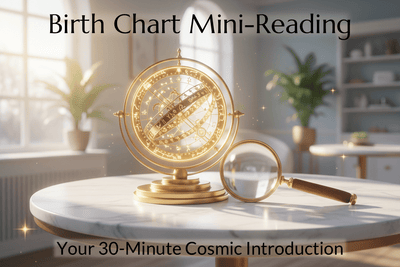
The Moon Bath Ritual for lunar-aligned soaking extends this into the lunar cycle, offering specific practices for new moon and full moon phases. If you would like to understand which elemental approach is most attuned to your natal chart and current transits, the Astrology Mini Reading is a precise starting point.
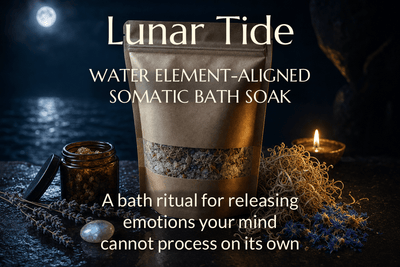
The LWA elemental bath soaks are formulated with this attunement in mind, each one carrying a specific elemental and somatic signature developed for the particular nervous system quality that element invites. They are not treatments. They are sensory companions to a practice you already know how to receive.