
There is a particular quality to the mind after a deep exhale. The crowded noise of it settles briefly. The thoughts that were stacked on top of each other find a little more space between them. You can see what was actually there. This is Air's gift: not the absence of thought, but the capacity to hold thought lightly enough that it does not become the whole of your inner landscape. Air element rituals bring clarity and they are about cultivating that quality of space, not as an escape from the mind, but as a more honest and useful relationship with it.
What Air Feels Like in the Body
Air is the element you feel most directly in the breath. The specific quality of a long, unhurried exhale is Air's most immediate somatic signature: the way the shoulders drop, the way the chest softens, the almost involuntary sound that escapes when you have been holding something without knowing it and finally let it go. Air in the body is associated with lightness, with movement, with the particular mental aliveness of an idea that has just arrived.
Air also lives in the throat, that vulnerable passage where inner experience becomes outer expression. And it lives at the boundary of the skin, where the inner world meets everything outside it. Wind on the skin is one of the most immediate ways the element announces itself: that sudden outdoor aliveness, the sense of being awake to the world in a way that indoor spaces rarely offer. When Air is moving well, the mind feels spacious without being scattered. When Air is stagnant, the mind becomes foggy, repetitive, or stuck in loops. The breath has grown shallow. Something that should be moving has stopped.
Air in Astrology: Gemini, Libra, and Aquarius
The three Air signs share an orientation toward thought, connection, and the movement of ideas. Gemini is Air in its most mercurial expression: quick, curious, forever gathering information without always needing to synthesize it. Libra is Air as relationship: the capacity to hold multiple perspectives simultaneously and find the balance point between competing realities. Aquarius is Air as vision: the long view, the systemic perspective, the ability to see patterns across populations and time horizons that others miss.
What all three share is a natural comfort with abstraction and a gift for communication. Air signs tend to process experience by talking about it, writing about it, or finding the idea that makes sense of it. For those without strong Air placements, these qualities may feel like capacities to develop rather than native fluencies. The article on elemental signatures in the birth chart offers a practical method for reading your own elemental makeup.
Air and the Body: Lungs, Nervous System, and the Skin as Boundary
Air's primary physical home is the respiratory system: the lungs, the diaphragm, the entire architecture of breathing. But Air's body terrain extends further. The nervous system, running from the brainstem through every inch of the body, is Air's interior landscape. Nerve signals travel at speeds that feel like thought, because in a meaningful sense they are thought.
Studies in Frontiers in Human Neuroscience demonstrate that deliberate manipulation of breath rate and depth produces measurable changes in heart rate variability (HRV), a key marker of vagal tone and nervous system resilience. When Air is intentional, the entire body hears it.
The Throat chakra (Vishuddha) sits at Air's energetic center. The Himalayan Institute's teaching on Vishuddha describes this center as governing not just speech, but the purification of expression: the capacity to say what is real, to mean what you say, and to let inner truth become outer language. When this center is open, communication feels natural, honest, and unhurried. When it is contracted, words feel stuck, truth feels risky, and the throat carries a familiar tightness.
Signs That Air Is Depleted
Air depletion tends to announce itself through the mind and the breath before it shows up in behavior. Some recognizable signs:
- Mental fog: the inability to think clearly, to prioritize, or to hold an idea long enough to work with it
- Difficulty communicating truth, a pattern of either over-explaining or going silent when direct expression is called for
- Shallow breathing that has become the default rather than the exception
- A sense of disconnection from ideas, from curiosity, from the pleasure of thinking
- Indecisiveness that feels different from careful consideration: more like paralysis than discernment
- A heaviness in the head, a kind of pressure that does not release
Air depletion often follows periods of intense emotional or physical demand, when the body has been directing all its resources toward other priorities. If you recognize these patterns across multiple elements, the elemental imbalance guide covers depletion and excess for each element in depth.
Core Air Practices
Pranayama and Breathwork Varieties
Pranayama offers perhaps the most direct and reliable route to Air element cultivation. Nadi Shodhana (alternate nostril breathing) balances the two hemispheres of the brain and brings a quality of centered, bilateral thinking. Bhramari (humming bee breath) involves a sustained hum on the exhale while the fingers gently cover the ears, creating vibration that resonates in the skull and throat and directly engages the Throat chakra. Both practices may be explored in five-to-ten-minute sessions, observing what shifts in the quality of the mind afterward.
Journaling and Automatic Writing
Air processes experience through language. The key distinction, from an elemental perspective, is between journaling as analysis (organizing and explaining experience) and automatic writing (letting the hand move without editorial oversight). Automatic writing moves with Air's actual nature rather than constraining it. Consider setting a timer for ten minutes, placing the pen on the page, and following wherever it leads. Many people find that clarity arrives not through the writing itself, but in the pause immediately after, when the mind is emptied enough to hear what was underneath.
Singing, Toning, and Sound
The voice is Air made audible. Toning (sustaining a single note or vowel sound) directly activates the vagus nerve through the throat and creates sympathetic resonance in the chest and skull. Many people who feel stuck in Air, who find their voice diminishing under stress, find that regular toning practice gradually rebuilds the felt sense of their own inner authority.
Open-Air Movement
Moving the body through outdoor air delivers Air in its most elemental form. The widening of the gaze, the deepening of the breath, the sense of being part of a larger system: these may support mental clarity in ways that indoor environments cannot replicate. Consider a walk taken specifically for the quality of thought it produces rather than the distance covered.
Air Ritual Toolkit
Resinous and Herbal Smoke
Smoke is Air's most ancient ritual ally. Incense, smoke bundles, and resin burning have been used across virtually every ritual tradition to mark sacred space and work with the liminal quality of Air. For clarity work, frankincense resin is among the most consistently cited cross-cultural tools, used in Eastern Orthodox ceremony and Ayurvedic practice alike. White sage, palo santo, and rosemary all carry clarifying qualities. LWA's incense collection includes options suited to Air element ritual space.
Clarity Anointing Blends
For anointing work aligned with Air's clarifying and communicative qualities, LWA's Abundant Truth and Tongue of Angels blends are formulated specifically for Throat chakra and Air element work. Applying these to the throat, the temples, or the inside of the wrists before speaking, writing, or any practice requiring clear communication may support the body's somatic readiness for that expression. The full range of anointing oils includes additional options.
Sound Tools: Bells and Singing Bowls
The sustained tone of a singing bowl creates an auditory anchor that the mind can use to release its grip on whatever it has been holding. The precise, clear tone of a bell marks a transition: the beginning or end of a practice, the boundary between ordinary time and sacred time. Both tools are worth exploring for the quality of attention they invite. The sound simply creates space.
Feathers and Air Gesture
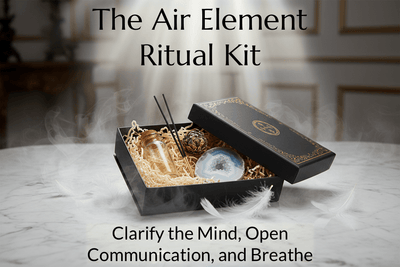
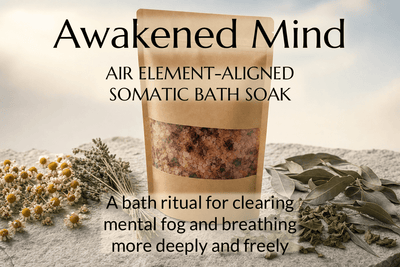
Feathers appear as Air symbols across traditions because they make air visible: they move with invisible currents and make those currents perceptible. Using a feather to move smoke across the body or around a ritual space is a way of working with Air's cleansing and clarifying properties in a direct, sensory way. For a complete Air-aligned starting point, the Air Element Ritual Kit is a curated set for elemental Air practice. For the somatic bathing dimension of Air work, the Breathwork Somatic Soak is formulated for Air element immersion practice, particularly suited to soak sessions accompanied by breathwork or toning.

Air and Thought: Witnessing the Inner Weather
Air's highest offering may be the one that most contemporary life makes hardest: the capacity to observe the mind without being fully identified with it. It is like learning to sit at a high window and watch the weather in the valley below. The weather is real: the clouds, the wind, the occasional storm. But you are watching from a vantage point that gives you perspective.
Research in Clinical Psychology Review on mindfulness-based practices suggests that the capacity to observe one's own thoughts as transient mental events rather than fixed truths is associated with significant improvements in psychological flexibility, emotional regulation, and the ability to respond rather than react. Air is not just the element of thought but the element of meta-cognition: the capacity to notice the patterns of the mind without being consumed by them.
An Invitation to Breathe
Air asks almost nothing to begin with. It is already here. The next breath is already available. The question is only whether you will take it with presence.
If you are ready to deepen Air element practice, the Air Element Ritual Kit offers a beginning. For the broader elemental landscape within which Air finds its meaning in relation to Earth, Fire, and Water, the four elements ritual practice guide is the foundational map. And if Air imbalance is part of a larger elemental picture, the elemental imbalance guide offers a clear way to understand what is depleted and what may be in excess.
Take a breath. Notice whether it goes all the way in. Notice whether you let it all the way out. What does the quality of your breath tell you about the state of your Air element right now?