
The night before the full moon, many people notice something shift in the body before they notice it in the sky. Sleep becomes lighter. The mind runs later into the night. There is a restlessness that has no obvious cause, a low-level charge in the tissues, a sensitivity that seems to arrive from the inside rather than from anything happening outside. You may have attributed it to stress or caffeine or the particular week you were having. But if you have tracked it across several months, you may have noticed a pattern: the body knows the moon is full before the calendar confirms it.
The human body is approximately 60 percent water. The moon moves tides through bodies of water far larger than ours, and research published in Science Advances has documented measurable correlations between lunar phase and human sleep architecture, with individuals showing later sleep onset and reduced total sleep time in the days approaching the full moon. If the moon moves the ocean, it is worth considering that it might also move the fluid body. A moon bath ritual begins with this consideration and builds from it into practice.
The Moon and the Body: What the Research Suggests
Infradian rhythms are biological cycles longer than 24 hours. The 29.5-day lunar cycle is the most widely recognized, and its correspondence with human biology extends further than sleep. The menstrual cycle's approximate 29.5-day rhythm echoes the lunar cycle so closely that several researchers have proposed an evolutionary relationship, the body's internal clock calibrated over millennia to the same rhythmic pulse that governs the tides.
Research into lunar-phase effects on human biology is still developing and should be held with appropriate nuance. The 2021 University of Washington study on lunar sleep cycles, for instance, found statistically significant disruptions to sleep architecture around the full moon, but the effect size was modest and varied considerably between individuals. What this points toward is not that the moon controls human behavior, but that the body is a permeable system, responsive to rhythmic cycles in the environment that we have only recently begun to measure with precision. For those who have always sensed this, the science offers grounding rather than revelation.
Cortisol levels, emotional intensity, and sensitivity to stimulation all appear to fluctuate across the lunar month for some people, particularly those who track their experience closely. The full moon phase tends toward activation and surface-rising; the new moon phase tends toward quiet and interior. This is the somatic basis of the moon bath practice.
What a Moon Bath Is
A moon bath is a ritual bath timed to one of the lunar cycle's key threshold moments. The two most commonly worked with are the new moon (the dark of the moon, day one of the cycle) and the full moon (peak illumination, day fourteen to fifteen). The bath becomes a somatic vehicle for the energetic qualities those phases carry: the new moon's quality of emptiness, receptivity, and new beginning; the full moon's quality of fullness, visibility, and release.
The practice has roots in multiple traditions. In Japanese Shinto practice, misogi, ritual water purification, has been performed in relation to lunar timing for centuries. Ayurvedic medicine prescribes specific lunar bathing practices as part of the broader panchanga (five-limb calendar system) that governs the timing of practices for health and spiritual alignment. In folk and Wiccan traditions, lunar bathing and the preparation of moon water are foundational practices for working with the lunar cycle intentionally.
The moon bath is accessible at any level of familiarity with lunar practice. You do not need to track transits or know your moon sign for this practice to be felt in the body. The cycle itself provides the structure. Your body provides the rest.
Preparing Moon Water
Moon water is water that has been left outside, or on a windowsill where moonlight can touch it, overnight during a significant lunar phase. The practice exists in folk traditions across Europe, in Wiccan practice, and in several indigenous lineages, each with their own specific protocol and meaning. The simplest form: fill a clean glass jar or bowl with water, place it where moonlight will fall on its surface, cover it loosely (to keep it clean), and leave it through the night. In the morning, the water carries the charge of the moon's phase.
Moon water can be added directly to the bath, held in a dish on the bath ledge as a visual anchor, or used to rinse the face and hands at the ritual's close. It is a simple, beautiful way to extend the connection between the body and the lunar field.
The New Moon Bath: Intention and Opening
The new moon is darkness: the sky's reset, the beginning before the beginning. The moon is present but invisible, turned toward the earth with its unilluminated face. In somatic terms, this is a moment of quiet inwardness, the nervous system's invitation to rest, to receive, to open toward something not yet visible.
Within the Living Wisdom Integration Cycle, the new moon is a Stage 1 Awakening moment: the body as receiver, the intention as seed. The new moon bath reflects this quality in every dimension of its design.
Consider cooler water temperature for the new moon, warm enough for comfort but not the full heat of a releasing bath, the body more alert and receptive rather than dissolved. The room benefits from quietness and simplicity: white or black candles (white for clarity and intention, black for the fertile dark of new beginnings), minimal scent or a single clean note. Botanicals traditionally associated with intention and opening include mugwort (Artemisia vulgaris), used in Western herbalism and many indigenous traditions as a plant of the threshold and the dreaming mind; white roses, associated in Ayurvedic and Western tradition with purity and new beginning; and jasmine, long used in South Asian and Middle Eastern traditions for its opening, receptive quality.
If you have prepared moon water from the new moon night, adding it to the bath directly connects the practice to the lunar field in a tangible, sensory way.
The new moon bath's central practice is the holding of a single intention. Not a goal, not a wish, but a quality: the felt sense of what you are opening toward. Where does it live in the body? In the chest, as a warmth? In the throat, as a readiness to speak? In the belly, as a quiet settling? Hold it there, not in the mind but in the body.

The Full Moon Bath: Release and Surrender
The full moon is fullness: the cycle at peak illumination, everything visible, everything risen to the surface. Many people find the full moon phase brings emotional intensity, not in a way that is always comfortable, but in a way that has a quality of completeness, of things that have been accumulating through the month arriving at their threshold. What has been held through the waxing weeks is now ready to move.
The full moon bath's somatic invitation is release. The warm water becomes the container that holds what the body is ready to let go. This is not a conceptual exercise. The physical warmth, the mineral drawing quality of sea salt or Epsom salt in the water, and the parasympathetic shift described in the foundations of a complete ritual bath practice all create genuine physiological conditions in which the body can discharge held tension and stored activation.
Warmer water than the new moon bath, closer to the full therapeutic temperature of 40°C (104°F). Sea salt or Epsom salt as the primary mineral: the drawing, releasing quality of salt in warm water is a real somatic phenomenon, many people describe it as a physical lifting off. Botanicals of release include lavender, whose linalool content supports the olfactory-limbic parasympathetic response; eucalyptus, whose eucalyptol creates an opening in the chest and throat; and rosemary, Western herbalism's great clarifying herb. Silver or white candles carry the full moon's own quality of light and reflection.
The full moon bath's practice centers on the exhale. Not a controlled breathing exercise, but a quality of attention: with each breath, allow the exhale to be slightly more complete than usual. Let the ribs drop. Let the belly release. The body's work here is not intellectual. It is the actual physiological exhale, the softening of the grip in the diaphragm and the jaw and the hands. The water holds what you release. You can let it go.
A Note on the Body's Response
Some people find that the full moon bath invites tears. This is welcome and appropriate. Emotional tears carry elevated cortisol and stress hormones, and weeping is one of the body's biochemical pathways for releasing what has accumulated. The privacy and warmth of the bath creates conditions in which tears can arise without social complexity.
Moon Water and Its Traditions
The preparation and use of moon water has specific roots in multiple traditions and deserves to be attributed rather than generalized as simply "ancient wisdom." In Western folk and Wiccan practice, moon water is prepared under the full moon for use in clearing, protection, and manifestation work. In Ayurvedic practice, water exposed to the full moon (chandrajala, or moon water) is considered to carry the cooling, nurturing quality of the lunar energy and is sometimes drunk or used in bathing preparations during Pitta-dominant seasons. In several indigenous North American traditions, water gathered at the full moon carries ceremonial significance that varies by specific nation and lineage and can be respectfully acknowledged as part of a much broader human recognition of lunar water's particular quality.
Other Lunar Phases: A Brief Acknowledgment
The new and full moon are the most commonly worked with thresholds, but the waxing crescent, first quarter, waxing gibbous, waning gibbous, last quarter, waning crescent, and dark moon each carry their own qualities and offer their own invitations to the soaking practice. The waxing moon supports building and growing intentions; the waning moon supports gradual release and completion.
To pair your bath with the intention-setting power of the dark sky, see the New Moon Ritual Guide.
For those wanting to extend the lunar bath into a complete new moon practice, a broader new moon ritual guide will be available in the Ritual Library.
Building a Consistent Lunar Bath Practice
The power of this practice is in the return. A single moon bath offers the immediate somatic experience of the warm water, the intention, the release. But something different happens when you return to the practice across several lunar cycles: the body begins to recognize the pattern. The nervous system develops what might be called a lunar rhythm memory, a felt sense of the cycle's pulse that begins to be accessible between baths, not just during them.
Many people find that bathing at both the new and full moon for three to four complete lunar cycles begins to create a tangible somatic calibration. The restlessness of the pre-full-moon days becomes more navigable when you know the bath is coming. The quiet of the new moon becomes a genuine felt reset rather than just a point on a calendar.
This is not a requirement. It is an invitation to notice. If bathing at both lunar thresholds each month feels like too much, consider choosing one, the phase whose quality feels most relevant to where you are in your own cycle right now, and beginning there.
If you would like to understand your own lunar signature more precisely, including your natal moon sign and the current moon transits that are most active in your chart, the Astrology Mini Reading offers a focused reading that includes your lunar placement and what it suggests about how you are wired to receive and release.
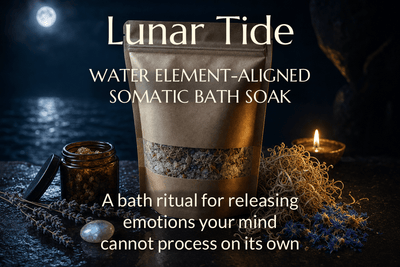
For a somatic companion formulated specifically for water-element practice and lunar alignment, The Trance State Somatic Soak is the LWA offering designed for exactly this kind of deep, receptive immersion. Consider bringing it to your next lunar bath as a sensory anchor for the practice.