
Something feels off. Not in any dramatic way, nothing you could easily name. It is more like a low hum beneath the day: a restlessness in the legs when you need to be still, or a flatness in the chest where enthusiasm used to live, or a circular quality to your thoughts that no amount of fresh air seems to untangle. What you may be sensing is elemental imbalance, and the first gift of noticing it is simply this: it has a name.
The four classical elements, earth, fire, water, and air, describe living qualities that move through the body, the psyche, and the rhythms of daily life. When those qualities fall out of proportion, whether through depletion or through excess, the whole system feels it. This article is here to help you recognize which element is asking for attention and to offer a gentle path toward restoration. If you are new to the elemental framework, the four elements ritual practice guide is a useful place to begin.
One thing worth naming early: imbalance is not failure. The elements are always moving. Research on allostatic load, the cumulative wear that comes from repeated adaptation to stress, confirms what many wisdom traditions have long described: the body is in constant dynamic negotiation with its environment. Finding yourself temporarily low in one element, or flooded by another, is part of being a living, responsive creature. It is the recognition that matters, not the diagnosis.
Depletion and Excess: Two Faces of the Same Imbalance
Most discussions of elemental imbalance focus only on what is missing: not enough Fire, too little Earth. But excess is just as real and just as disorienting. An overabundance of one element creates its own kind of suffering, and it often goes unrecognized because it can look like strength. Someone with excessive Fire energy may appear highly productive right up until the moment of collapse. Someone with excessive Water may be praised for their emotional sensitivity without anyone noticing that they are quietly drowning in it.
A useful way to think about this: depletion feels like absence, a kind of hollowing. Excess feels like overwhelm, a kind of flooding or constriction. Both call for attention. The Ayurvedic concept of dosha imbalance offers a parallel framing: Ayurvedic medicine describes both deficiency and excess in each constitutional type, recognizing that health is a matter of proportion, not simply of having enough.
The following element-by-element guide covers both patterns. As you read, notice what lands in the body rather than trying to analyze it from a distance. Recognition often arrives as a physical sensation before it arrives as a thought.
Earth: Depletion and Excess
When Earth Is Depleted
Earth depletion often begins as a kind of rootlessness: a feeling of floating just above your own life, moving through tasks without inhabiting them. Difficulty finishing things arrives, not because you lack motivation exactly, but because commitment feels risky. There may be physical restlessness that no amount of movement resolves, anxiety in the stomach or legs, and a loosened relationship with your own body. Sleep may feel thin. Appetite may be erratic.
Earth depletion can come from long periods of instability, frequent moves, emotional upheaval, or sustained time in highly mental environments without physical counterbalance. The body needs earth. Without it, the nervous system has no floor.
When Earth Is Excessive
Excess Earth shows up as a heaviness that feels permanent, a resistance to change that crosses into rigidity, a sedimentation in both body and mind. Routines that once felt grounding may become prisons. Emotionally, excess Earth can manifest as stubbornness or a difficulty releasing what is no longer serving, whether that is a relationship, a habit, or an old identity.
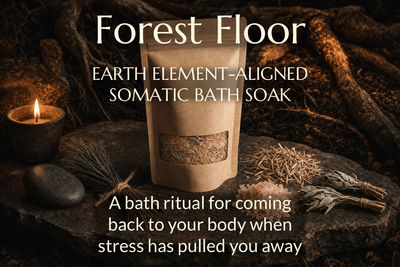
To explore Earth restoration rituals in depth, the Earth element grounding rituals guide offers both practices and context. For those experiencing Earth depletion in particular, the Somatic Elemental Bath Soaks and the Sacred Ritual Kits offer grounded starting points.
Fire: Depletion and Excess
When Fire Is Depleted
Low Fire is one of the most common patterns in people who have been living in survival mode too long. It presents as a persistent flatness in motivation: things that once excited you now feel distant, like looking at photographs of someone you used to love. Boundaries become difficult to hold, not because you do not want them, but because the will to enforce them feels exhausted. Digestive sluggishness is common, and there may be a literal coolness in the body, cold hands and feet, a difficulty warming up.
When Fire Is Excessive
Excess Fire is the pattern of burnout after giving everything you have. It looks like productivity and boldness, but underneath the nervous system is running hot. Sleep becomes difficult because the mind will not slow. Irritability rises; small provocations produce large heat. There can be inflammatory patterns in the body and a quality in relationships of control or an unconscious belief that others cannot be trusted to move fast enough. Fire, when it has no container, consumes what it means to illuminate.
The Fire element rituals guide explores both activation and the shadow of Fire with care.
Water: Depletion and Excess
When Water Is Depleted
Water depletion has a particular texture: a dryness in places that are meant to be fluid. Emotional numbness is often its most prominent feature, not the absence of pain, but the absence of movement through feeling. Grief stalled. Joy gone flat. Intuition gone quiet, replaced by a reliance on logic that feels effortful. There may be physical signs too: dry skin, a stiffness that is not purely muscular. In relationships, Water depletion can show up as difficulty with intimacy, a guarding of the inner world that has slowly hardened from protective into isolating.
When Water Is Excessive
Excess Water is the quality of being swept. Emotions arrive in waves that feel impossible to navigate: overwhelm, grief flooding into everything, difficulty making decisions because every choice carries too much feeling. There may be a tendency to take on others' emotional states as your own, what some somatic practitioners describe as difficulty with the boundary between self and field. Water is the element of depth, and when it exceeds its container, it floods.
For Water restoration practices, the Water element rituals guide offers tools for tending the fluid body.

Air: Depletion and Excess
When Air Is Depleted
Air depletion arrives as a mental fog that is not quite fatigue: more like trying to think through gauze, ideas just out of reach, words that do not come easily. There may be shallow breathing that has become habitual, a pattern of holding the breath during stress. Creative thought, which Air feeds, goes quiet. In the body, Air depletion can show up in the throat as tightness or difficulty speaking truth.
When Air Is Excessive
Excess Air has the signature of dissociation: a quality of being everywhere at once and nowhere solidly. The mind races between ideas without settling, and anxiety takes on a particularly unmoored quality. There may be difficulty with embodiment, a floating sense of being primarily cerebral. Sleep may feel light or fragmented, and the mind generates more options than the body can act on.
For Air restoration practices, the Air element clarity guide offers breathwork and somatic tools for restoring Air to its most useful, clear quality.
Practical Restoration: Matching Practice to Element
The general principle of elemental restoration is intuitive once identified: depletion calls for more of the element, offered gently and consistently. Excess calls for its grounding opposite, or for creating more container around the flooded element. Earth and Water anchor and slow. Fire and Air move and clarify. But these are tendencies, not rules, and your own body is the most reliable guide.
- Earth depletion: Practices that involve physical weight and contact, walking barefoot, stone work, root botanicals, slow full-body movement. Ritual tools that carry the scent and texture of earth.
- Earth excess: Introducing gentle movement, breathwork, and practices that create flow and lightness. Fire and Air elements may be gently invited to help move what has become stuck.
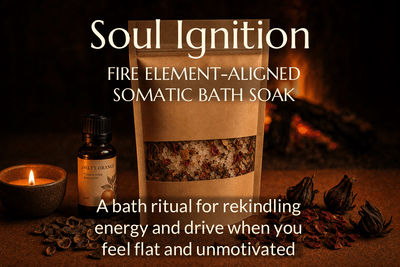
- Fire depletion: Candle-gazing, activating breathwork, warming botanicals, bold intentional movement. Practices that rekindle rather than push. The Heart Coherence Somatic Soak may support the body's readiness to receive Fire energy.
- Fire excess: Cooling, grounding practices. Earth and Water elements invited to contain the flame. Longer exhales in breathwork. Stillness before action.
- Water depletion: Ritual bathing, moon-gazing, emotional journaling, somatic practices that create space for feeling to move. The Trance State Somatic Soak may help the body return to its fluid nature.
- Water excess: Grounding Earth practices, physical structure and routine, Fire's warmth and directedness. Practices that offer the contained safety of form, within which feeling can move without flooding.
- Air depletion: Conscious breathwork, singing or toning, open-air movement. Writing by hand to anchor thought in form.
- Air excess: Earth grounding, slower breath rhythms that lengthen the exhale, body-weight practices that return awareness to physical sensation.
When Ritual Is Not Enough: A Gentle Note
Elemental practices are powerful tools for tending the nervous system and creating conditions for wellbeing. They are ritual tools, not medical treatments. If you are experiencing persistent patterns that feel beyond the reach of self-practice, including significant impacts on sleep, mood, relationships, or daily functioning, it may be worth exploring support from a somatic practitioner, therapist, or other qualified guide. Imbalance that has roots in trauma, chronic illness, or nervous system dysregulation deserves professional care alongside personal ritual.
Many signs of elemental imbalance are also nervous-system states; the guide to somatic ritual offers a complementary lens.
Ritual works beautifully as a complement to other forms of support. The two do not compete.
Starting Where You Are
You do not have to have everything figured out before you begin. If you are not sure which element is asking for attention, consider the Embodied State Assessment quiz, which may help you find a starting point based on what you are actually experiencing in your body right now. From there, the element-specific guides for Earth, Fire, Water, and Air each offer practices tailored to that element's specific gifts and needs.
The elements are always cycling. What is depleted today can be restored. What is flooding now can find its banks. The work is not to achieve a static perfection, but to stay in a living, attentive relationship with what is moving through you. That attentiveness, cultivated through consistent practice, is itself a form of elemental balance.
Browse the full range of ritual support in the Sacred Ritual Kits and Somatic Elemental Bath Soaks collections, and let what calls to you be your guide.