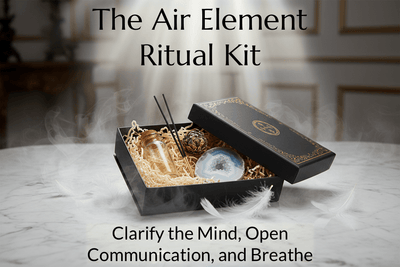

You have probably encountered both of these maps. The chakras: seven luminous centers arranged along the spine, each with a color, a sound, a quality of consciousness. The four elements: earth, fire, water, and air as the living forces that compose both world and self. They feel like they should fit together perfectly. In some places they do. In others, the edges blur and the correspondence resists being forced. The chakra system elements map that follows is LWA's honest attempt to hold both systems with integrity, to name what aligns, to name what diverges, and to offer you something more genuinely useful than a forced correspondence that sounds tidy, but leaves you confused in practice.
Two profound maps of the same interior territory arrived at different times, in different cultural and cosmological contexts, using different organizing principles. Understanding where they illuminate one another, and where they remain distinct, is what makes this framework actually usable. For a grounding in the elemental framework itself, the four elements ritual practice guide offers the complete foundation this article builds on.
A Brief Orientation to the Chakra System
The chakra system originates in the tantric and yogic traditions of South Asia, with its earliest systematic descriptions appearing in the Tantric scriptures of the sixth to ninth centuries CE. The word chakra means "wheel or disk" in Sanskrit, and the system maps seven primary energy centers along the central channel of the subtle body, each governing particular dimensions of physical, psychological, and spiritual life.
The seven classical chakras, from base to crown:
- Muladhara (Root Chakra): Located at the base of the spine. Governs survival, belonging, physical safety, and the relationship to the body itself. Associated with the color red and the sense of smell.
- Svadhisthana (Sacral Chakra): Located in the lower belly, behind the navel and below. Governs creativity, pleasure, emotional flow, sexuality, and the capacity for intimacy. Associated with the color orange and the sense of taste.
- Manipura (Solar Plexus Chakra): Located at the solar plexus, between the navel and the sternum. Governs personal power, will, digestion of experience, and self-definition. Associated with the color yellow and the sense of sight and action.
- Anahata (Heart Chakra): Located at the center of the chest. Governs love, grief, compassion, the capacity for connection, and the integration of personal and transpersonal. Associated with the color green and the sense of touch.
- Vishuddha (Throat Chakra): Located at the throat. Governs authentic expression, communication, listening, and the alignment between inner truth and outer word. Associated with the color blue and the sense of hearing.
- Ajna (Third Eye Chakra): Located at the center of the forehead, between and slightly above the eyebrows. Governs intuition, perception, pattern recognition, and the capacity to see beyond the obvious. Associated with the color indigo and the faculty of perception beyond the five senses.
- Sahasrara (Crown Chakra): Located at the top of the skull and extending above it. Governs connection to the larger field, spiritual awareness, and the dissolution of the boundary between self and wholeness. Associated with the color violet or white.
A Brief Orientation to the Four-Element Framework
The classical four-element framework, developed across Greek, Ayurvedic, and other traditional systems, maps the qualities of earth (solid, slow, foundational), fire (transformative, metabolic, willful), water (fluid, feeling, connective), and air (communicating, mobile, perceptive) as the primary expressions of life-force in the physical and energetic body. Each element has a body location, a psychological signature, and a ritual dimension. For a full account of this system, the four elements pillar serves as the complete reference. What matters for this article is a second dimension of the Ayurvedic system worth naming here: the Pancha Mahabhutas include a fifth element, Akasha (ether or space), which governs the subtlest and most expansive qualities of existence. This fifth element is what allows a more nuanced correspondence with the upper chakras.
The Correspondence Map: Where the Systems Align
The lower chakras have the cleanest elemental correspondences, and these are the places where working with both maps simultaneously offers the clearest ritual guidance.
Earth and the Root Chakra
The correspondence here is deep and reliable. Both Earth and Muladhara govern the foundational: the relationship to the body, to safety, to belonging, to the densest physical structures. Earth's body domain of bones, skin, and the gut's inner landscape aligns with the Root Chakra's governance of physical safety and embodied survival. Ritually, practices and tools that tend Earth also tend the Root Chakra: grounding into the body, establishing safety in the nervous system, working with root botanicals and dark stones. The Earth element ritual guide explores this territory in depth.
Water and the Sacral Chakra
Water and Svadhisthana align with equal clarity. Both govern the fluid, the feeling, the creative, and the relational. The Sacral Chakra's association with the element of water in the classical yogic texts is explicit, and in practice the correspondence holds: tending Water supports the Sacral Chakra's emotional and creative life, and working with the Sacral Chakra through ritual, water, and somatic attention tends the Water element's physical expression in the lymphatic and endocrine systems. The Water element ritual guide provides the elemental entry point.
Fire and the Solar Plexus Chakra
Fire and Manipura align with clarity and power. Both govern will, metabolic processes, the digestion of experience, and the formation of a coherent self. The Solar Plexus Chakra is fire's primary home in the chakra system, and this correspondence is among the most useful in practice: when the solar plexus feels contracted, cold, or absent, Fire ritual practices may support its re-engagement; when it is burning too hot, Water and Earth practices may offer regulation. The Fire element ritual guide is the companion reading.

Where the Maps Diverge: An Honest Account
This is the section that most chakra-element content omits, and its absence is a real disservice to the practitioner. The correspondence between four elements and seven chakras is not and cannot be a perfect one-to-one mapping. Seven does not divide cleanly into four. The two systems emerged from different cosmological frameworks, different cultural contexts, and different organizing purposes. Forcing a rigid correspondence where one does not naturally exist creates confusion, not clarity.
Here is where the difficulty concentrates:
The Upper Chakras and the Element of Air (or Space)
In many popular presentations of chakra-element correspondence, the Heart Chakra is assigned to Air, and the upper chakras (Throat, Third Eye, Crown) are either left without a clear elemental home or awkwardly distributed among the remaining elements. This creates a problem: the Heart Chakra's energetic signature does not feel like Air in the classical sense. The Heart governs love, grief, and the depth of connection, qualities that in the emotional body have more in common with Water's depth and Fire's warmth than with Air's lightness and movement.
The Ayurvedic Pancha Mahabhutas offer a more nuanced path: Akasha (ether or space) is the element that governs the subtler, more expansive dimensions of consciousness, the qualities that the upper chakras carry. Assigning the Heart, Throat, Third Eye, and Crown to a continuum from Air to Ether-Space, rather than forcing all four into a single elemental assignment, reflects both traditions more faithfully.
LWA's working synthesis holds it this way:
- Heart Chakra: A threshold between the elemental and the transpersonal. Air in its quality of bridge and connection; also the element of integration across all four.
- Throat Chakra: Air most directly: breath, sound, the nervous system's vocal expression, the interface between inner knowing and outer word.
- Third Eye Chakra: The Ether-Space dimension of Air: the perceiving faculty that moves beyond physical sensation into pattern recognition and inner sight.
- Crown Chakra: Space-Ether: the element before and beyond the four, the ground from which all elemental differentiation arises and to which it returns.
This is not a perfect map. It is a working map, offered in the spirit of genuine inquiry rather than false precision. The Heart's complexity, in particular, resists any single elemental assignment and may be best held as the place where all four elements are simultaneously present.
The Cultural Distance Between Systems
The Greek and European elemental framework and the Indian chakra-Tantric framework developed independently, with different philosophical assumptions, different relationships to the physical body, and different purposes. The chakra system is fundamentally a map of consciousness as it moves through increasing subtlety from matter toward spirit. The four-element system is fundamentally a map of how life-force expresses itself in the physical and energetic world. Both are profound. Neither was designed with the other in mind. The places where they converge are genuinely illuminating; the places where they diverge are equally honest.
Using the Integrated Map in Practice
The most useful application of this integrated map is not achieving a perfect theoretical correspondence, but rather using both lenses to ask richer questions about the body's current state. Consider: if you notice the Solar Plexus area feels tight, hollow, or absent, you can approach it through the Fire element (with warming, activating practices) and through the Manipura Chakra's specific qualities (personal will, the digestion of experience, self-definition). The two lenses together offer more entry points than either alone.
Similarly, when Water or Sacral energy feels stagnant, you might notice both the body's fluid systems (lymphatic sluggishness, emotional flatness) and the Sacral Chakra's creative and relational dimensions. Ritual practices that address both simultaneously, a warm soaking bath with sacral-aligned intentions, for instance, tend to be more effective than those that address only one dimension.
The Integrated Map as Diagnostic
Reading your patterns through both lenses simultaneously is one of the more sophisticated practices in this framework. The question is not only "which chakra is calling for attention" or only "which element is depleted," but rather: where do both maps converge in pointing to the same area of the body and experience?
When Earth depletion and Root Chakra vulnerability are both present, the signal is strong and the ritual response can be correspondingly focused. When Fire excess and Solar Plexus over-activation coincide, both lenses point toward the same need: cooling, grounding, and compassionate containment rather than more activation. This kind of double-lens reading creates precision that neither system alone provides.
The elemental body map article explores the physical dimension of this diagnostic framework: how the elements express in the body's tissues, fluids, and systems, offering another layer of understanding for anyone working with this integrated approach.
Hub: Chakra-Related Cross-Links Across the Ritual Library
This article is the reference center for chakra-related content throughout the Library. As you deepen your practice, the following pages provide element-specific and chakra-specific guidance:
- Earth Element Grounding Rituals: Root Chakra and Earth element practices
- Fire Element Activation Rituals: Solar Plexus Chakra and Fire element practices
- Water Element Intuition Rituals: Sacral Chakra and Water element practices
- Air Element Clarity Rituals: Throat Chakra and Air element practices
- Working With Chakras in Daily Ritual: The practical companion to this article, with per-chakra tools and body-scan practice
- The Elements and the Body: How each element maps to physical systems
- What Is Bio-Spiritual Health: The larger framework within which both the chakra system and the elemental framework operate
Closing Invitation
Both maps are, at their best, invitations to pay attention. The chakra system asks: where along the axis from body to spirit is life-force moving freely, and where has it contracted? The elemental framework asks: which of the four primary expressions of life-force is present and vital in you right now, and which is asking to be tended? Holding both questions simultaneously is a practice in itself: a form of interior listening that becomes more refined the more it is exercised.
If you are drawn to working with these systems through anointing, the Anointing Oil collection includes element-aligned blends that can serve as ritual tools for both chakra and elemental practice.