
What if the body is not broken, but rather speaking in a language older than clinical categories? The elements body physical health framework offers exactly that: a way of reading your physical patterns through an elemental lens that holds both the rigor of traditional medicine systems and the spaciousness of sacred knowledge.
This is not a diagnostic protocol. It is an invitation to see the body as an ecosystem, animated by the same four forces that move through soil, flame, tide, and wind. When you begin to read your physical life this way, symptoms become messages, patterns become intelligible, and care becomes a form of elemental conversation.
The Body as an Elemental Ecosystem
Ancient traditions across cultures arrived at a remarkably similar conclusion: the human body is a microcosm of the world outside it. The same forces that govern seasons and weather also govern the interior landscape of flesh, fluid, nerve, and breath.
Ayurveda speaks of the Pancha Mahabhutas, the five great elements composing all matter, including the human body. Traditional Chinese medicine works with a five-element system in which each element corresponds to organ systems, emotional states, and seasons. Greek humoral medicine mapped the four humors onto the four classical elements, each governing particular bodily temperaments.
What these traditions share is the understanding that the body's health is inseparable from elemental balance. What you find in the broader four elements ritual practice guide as a framework for spiritual practice is also, in these systems, a map of physiological life. Modern somatic science offers its own version: research in interoception suggests the nervous system is continuously reading and modulating the body's elemental balance in temperature, fluid levels, metabolic rate, and respiratory rhythm.
Earth and the Body: Solidity, Structure, and the Inner Landscape
Earth governs the solid structures that hold everything else in place. In the body, Earth's domain includes the skeletal system (bones, teeth, dense connective tissue), the skin as boundary and containment, and the sense of smell, which both Ayurveda and Greek medicine link most closely to this element.
Perhaps most compellingly for contemporary understanding, Earth governs the gut microbiome: the dense inner landscape of microorganisms inhabiting the digestive tract. Research in the gut-brain axis has established that this microbial community communicates directly with the central nervous system via the vagus nerve, influencing mood, immune response, and stress reactivity. Earth's inner landscape is not merely symbolic: it is the literal soil from which much of the body's signal processing grows.
When Earth Feels Thin
Someone whose Earth element is depleted in the body may notice difficulty with physical presence: restlessness, inability to settle into stillness, joints that ache with unnamed tension, or a gut that is perpetually reactive. These are patterns worth noticing, not diagnoses. For somatic entry points to re-grounding, the Earth element grounding rituals guide offers a starting place.
Fire and the Body: Metabolism, Transformation, and Vitality
Fire governs everything that transforms: digestion, metabolism, hormonal signaling, and the heat-generating processes that sustain life. In Ayurvedic medicine, Agni (the digestive fire) is central to all health. When Agni is strong and steady, the body assimilates experience as efficiently as it assimilates food.
In the body, Fire's domain includes the digestive organs, the endocrine system, the immune system's inflammatory responses, and the Solar Plexus region. Fire depletion may feel like cold hands and feet, sluggish digestion, and difficulty generating motivation. Fire excess may present as chronic inflammation, heat in the joints, or a nervous system that cannot down-regulate. The Fire element ritual guide explores how intentional practice may support a more regulated relationship with this element.
Water and the Body: Fluidity, Feeling, and the Circulating Self
Water governs the body's fluid systems: blood, lymph, cerebrospinal fluid, synovial fluid, and the fluid environment of every cell. The body is approximately 60 percent water, and the quality of that water, its movement, its viscosity, its freedom of flow, reflects the Water element's health in the organism.
The lymphatic system is Water's most overlooked physical domain. Unlike the cardiovascular system, the lymphatic system has no central pump: it relies entirely on movement, breath, and the rhythmic compression of muscles and fascia to keep its fluid circulating. When Water stagnates in the body, whether through sedentary patterns, chronic tension, or emotional suppression, the lymph slows and the body's cleansing processes are compromised. Research on lymphatic function points to diaphragmatic breathing and gentle movement as primary drivers of lymphatic flow (Medicines), both of which are, in the elemental framework, Water-tending practices.
Water also governs the body's emotional chemistry: the hormonal landscape of cortisol, oxytocin, serotonin, and other messenger molecules that are, in a literal sense, the body's feeling language. The Water element's vitality is inseparable from the freedom to feel. For practices supporting the body's fluid and emotional systems, the Water element ritual guide offers a starting point.
Air and the Body: Nervous System, Breath, and the Communicating Self
Air governs the body's communicating systems: the nervous system and its vast signal network and the respiratory system as the body's primary rhythmic regulator.
The nervous system is Air's most sophisticated expression in the body. Research on polyvagal theory has expanded the understanding of how the autonomic nervous system orchestrates safety, connection, and mobilization responses throughout the entire organism via the vagus nerve. Breath sits at the intersection of voluntary and involuntary: it is the one place where Air's movement in the body can be consciously regulated, and therefore one of the most accessible portals for elemental self-tending.
For the embodied, regulatory dimension of this work, the guide to somatic ritual explores how the body holds and releases through practice.
When Air Becomes Scattered or Held
Air depletion in the body may present as shallow upper-chest breathing, a nervous system that never fully settles, or a mind that cannot find stillness. Air excess may appear as hyperventilation patterns or dissociation from physical sensation. The Air element ritual guide explores breath-based practices that may support a more regulated relationship with this element.

Traditional Frameworks: A Brief Survey
Ayurveda's three doshas (Vata, Pitta, Kapha) are each composed of two elements: Vata is Air and Ether; Pitta is Fire and Water; Kapha is Earth and Water. Traditional Chinese medicine's five-element system assigns each element an organ pair, a season, an emotion, and a flavor in a comprehensive relational map of the living body. Greek humoral medicine, though no longer a clinical system, preserved elemental body wisdom that informed European herbal practice for nearly two thousand years.
LWA's synthesis does not collapse these systems into one another. Each has its own internal logic and tradition. What this framework offers instead is a set of elemental lenses: ways of noticing your body's patterns through multiple traditions simultaneously, finding the places of resonance when different wisdom streams point in the same direction.
Working With Elemental Body Patterns Through Ritual
The bridge between elemental understanding and elemental practice is intentional attention. When you know that the Earth element governs your solid structures and your inner microbial landscape, a walk on bare ground, a bath with grounding botanicals, or an anointing practice with root-based oils becomes more than sensory pleasure: it becomes a coherent form of elemental tending. When you understand that the Water element governs both your lymphatic system and your emotional chemistry, a soaking bath with intentional presence or a practice of gentle movement becomes a form of elemental tending with physiological grounding.
The deeper invitation in this framework is toward a more intimate relationship with the body: not as a problem to be solved, but as an elemental being whose signals are intelligible, whose patterns are meaningful, and whose care is a sacred act. For a reading of how these body patterns intersect with the chakra system's energy map, the next stop is the integrated chakra and element map. The bio-spiritual health framework underlying all of LWA's work rests precisely on this premise: that body, psyche, and the sacred are a single living system, responsive to elemental attention at every level.
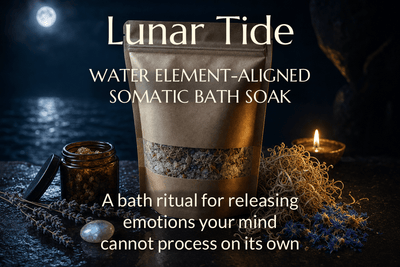
If you are drawn to supporting your body's elemental patterns through ritual bathing, the Somatic Elemental Bath Soaks are crafted around exactly this framework, each tending to a specific element's physical and energetic domain.