
Something shifts in the body during deep prayer. During the kind of meditation where the breath finally slows and the shoulders drop an inch without any effort. During ritual, when the candle is lit and the intention is set and something releases that you did not know you were holding. You have probably felt it: a softening, a settling, a sense of time expanding rather than contracting. The quality of presence that arrives quietly and with subtlety.
This is not imagination. It is not the placebo effect of going through meaningful motions. It is measurable. And one of the most precise measurements available for it is something cardiologists have studied for decades and contemplatives have embodied for millennia: heart rate variability. The field of heart rate variability spiritual practice research is finding, with increasing specificity, that what ancient traditions called sacred states and what physiology calls nervous system coherence may be describing the same underlying phenomenon.
What Heart Rate Variability Actually Measures
The Heart Is Not a Metronome
A common assumption is that a healthy heart beats steadily and evenly, like a clock. In reality, a healthy heart beats with variation: the time between one beat and the next is constantly, slightly changing, expanding and contracting in response to breath, to nervous system state, to the demands of the moment. This variation is called heart rate variability, or HRV.
High HRV means the nervous system is adaptable and responsive. The heart can speed up when needed and slow down when the demand passes. The system is resilient, capable of moving fluidly between activation and rest, between engagement and recovery. Low HRV tends to indicate a system under sustained strain: one that has been stuck in a defensive or activated posture long enough that its flexibility has diminished.
HRV is primarily regulated by the autonomic nervous system, and specifically by the vagus nerve's influence on cardiac rhythm. When the vagus nerve is functioning well, toning the heart toward rest and connection, HRV tends to be higher. When the sympathetic (fight-or-flight) branch is dominant, HRV tends to drop. For those who have explored the polyvagal theory of nervous system states, HRV can be understood as one of the clearest physiological windows into which state the system is currently inhabiting.
A Window Into the Physiology of the Soul
The Human Performance Resource Center has described HRV as "a window to understanding the physiology of your soul." That phrase is worth sitting with. Not a metaphor from a spiritual teacher, but a description offered by a human performance research center, one oriented toward military readiness and elite functioning. When that context uses the word "soul," it is pointing to something its researchers observed repeatedly: that the states associated with high HRV coherence are qualitatively different, not just physiologically but experientially. They feel meaningful. They feel like arrival.
And contemplatives across centuries have been reliably finding their way to these states through practices that, it turns out, are well-designed to produce them.

Spiritual Practices and HRV Coherence
Different Vessels, Same Physiological State
Research examining HRV during various spiritual and contemplative practices has found something remarkable: practices from very different traditions tend to produce similar physiological signatures. Sufi dhikr (rhythmic remembrance practices involving breath and repetition). Loving-kindness (metta) meditation. Contemplative Christian prayer. Slow breathwork traditions from yoga and Taoism. Across these very different cultural and theological contexts, researchers have observed increases in HRV coherence, a state in which the heart rhythm becomes more ordered and smooth, the breath and heart begin to synchronize, and the autonomic nervous system moves toward greater flexibility and ease.
The HeartMath Institute has conducted extensive research on heart coherence, describing a specific physiological state in which heart rhythm variability becomes highly ordered (rather than erratic), the nervous system synchronizes across multiple systems, and practitioners consistently report feelings of calm clarity, expanded perception, and emotional ease. What HeartMath calls coherence and what contemplatives call presence or centeredness appear to be, at minimum, deeply overlapping states.
This is the bio-spiritual bridge in its most precise form: science created a measurement for what practitioners across traditions have always known was real. The measurement does not diminish the experience. It confirms it. And understanding the physiology of these states can actually deepen access to them, offering a clearer map for practices the body already knows how to navigate toward.
Coherence Breathing as Ritual
One of the most well-studied pathways into HRV coherence is a practice sometimes called coherence breathing or resonance breathing: breathing at approximately five cycles per minute, which is slower than typical resting breath (which tends to be 12 to 20 cycles per minute for most adults). At around five breaths per minute, the breath rhythm begins to synchronize with a natural oscillation in the cardiovascular system called the baroreflex, and HRV coherence increases measurably.
Five breaths per minute means roughly a six-second inhale and a six-second exhale. It is slower than most people breathe in daily life, but it is not effortful once the body finds it. Many people describe it as feeling, somehow, like the right speed. Like the breath that was always available, but rarely used.
In ritual framing, this is not a biohacking protocol. The slow exhale is a practice of surrender. The extended inhale is a practice of receiving. The rhythm itself is a form of dropping into the body's ancient timing, a timing that was there long before the accelerated pace of modern life taught the nervous system to run faster than it was designed to.
This rhythmic quality connects to what is explored in the Living Wisdom Integration Cycle deep dive: the idea that the nervous system has its own timing, and that ritual is, in part, the practice of honoring that timing rather than overriding it.
An Invitation to Three Minutes of Coherence
The following is offered as an invitation, not an instruction. You know your own system. Some people find this practice profoundly settling from the first attempt. Others need a few sessions before the body finds the rhythm. Some will want to accompany it with scent or warmth or music. Some will prefer stillness. All of these are right.
If it feels resonant to try: find a comfortable seated position, or lie down if that is more accessible. Let the eyes close or soften. Begin to slow the breath gradually, not forcing it, just inviting it to lengthen. Aim for a six-count inhale and a six-count exhale. You might place a hand on the chest or belly to help anchor attention there. Let the breath become the center of awareness, and let everything else move to the periphery.
Three minutes at this pace is enough for most people to notice something shifting. A slight softening. A quality of spaciousness that was not there before. If it extends to five or ten minutes, something more substantial may arrive: the settling the HeartMath researchers describe, the state that contemplatives in many traditions have called, in their different vocabularies, centered, present, or held.
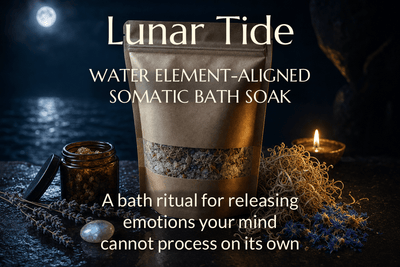
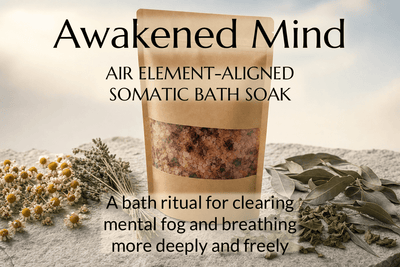
For those who find that somatic and sensory support deepens this practice, the Trance State Somatic Soak and the Breathwork Somatic Soak are formulated as ritual containers for exactly this kind of inward movement. The Water element soak for the deep, still coherence that arrives after surrender; the Air element soak for the breath-centered, expanding quality of coherence practices that work through rhythm and release. Either can become the sensory anchor that invites the nervous system to remember, again, how to arrive.