
Have you ever wondered why knowing your sun sign only tells part of the story? You read a description that fits some days perfectly and misses you entirely on others. The piece that tends to be missing is the rest of your big three astrology placements: your sun, your moon, and your rising sign working together as one layered system. When you see how these three relate to each other, something clicks. The chart stops feeling like a random collection of personality labels and starts feeling like a genuine map of the self.
This article moves through each layer one at a time, then shows you how to read the conversation between them. By the end, you will have a clear framework for building a ritual practice that honors all three dimensions at once rather than treating them as separate topics.
Why the Big Three Work as a System
Western astrology, as the Encyclopaedia Britannica's overview of astrology notes, has tracked the symbolic language of planetary placements for centuries. Within that tradition, your sun, moon, and rising sign are considered the three most personally defining points in a natal chart, because they describe three genuinely different dimensions of a single life.
The sun describes your conscious direction and vital force. The moon describes your emotional body and its nourishment needs. The rising sign describes how you meet the world at the threshold of each day, how the body orients before the conscious mind has caught up. Together, they address three distinct temporal rhythms: solar (daytime purpose, identity), lunar (night, feeling, tidal), and ascending (morning, threshold, the first moments of any encounter).
In depth astrology as practiced by writers like Liz Greene and Steven Forrest, these three placements are never treated as competing. They address different layers of the self at the same time. A person with a Capricorn sun, a Pisces moon, and a Gemini rising is not contradicting themselves. They are navigating solar discipline, lunar sensitivity, and increasing adaptability all at once, and that complexity is the actual texture of a human life rather than a problem to be resolved.
The invitation here is to stop asking which placement is the real you, and to start noticing how all three are present in a single ordinary hour.
The Sun: Your Vital Force and Direction
Your sun sign marks where your conscious identity and vital force seek expression. In Western astrology, the sun is traditionally associated with purpose, the heart, and the daytime self: the direction your life energy naturally wants to move, the mode through which you most easily recognize yourself when you feel genuinely alive.
From a ritual standpoint, the sun is the dimension of the self that responds to direction and intention. Solar practices tend to work best in daylight and involve some form of purposeful action: a morning statement of intent, a movement practice aligned with your sign's element, a creative act. Fire signs often find solar ritual easiest because solar energy is already native to their temperament. Earth signs may discover that solar practices land best when grounded in something tangible: a physical gesture, a list, a ritual object held in the hand.
Humanistic astrologer Dane Rudhyar described the sun as the seed pattern of purpose: a direction the whole life is orienting toward rather than a fixed trait already expressed. You might sit with that quietly: not what you already are, but what your life is becoming.
The Sun in Ritual Practice
You may find it useful to bring your sun sign's element into a morning practice: a brief intentional pause, a slow breath that lands in the sternum, a candle lit in your element's color. The chest is often where solar themes register, expanding when you are aligned with your purpose, tightening subtly when you are not.
The Moon: Your Emotional Body and Nourishment Needs
If the sun describes where you are going, the moon describes the conditions of safety that allow you to move there. In traditional Western astrology, the moon governs the emotional body, instinctual responses, and the inner atmosphere: the feeling tone that runs underneath conscious thought.
Your moon sign tends to surface most visibly when you are tired, stressed, or unguarded. The way your body contracts or opens in the first few seconds of a situation, before you have named what is happening: that is lunar territory. Astrologer Demetra George, whose work on the moon in traditional and Hellenistic astrology is widely referenced, frames the moon as the body's own intelligence, a system of needs that predates language and operates through feeling and instinct.
A Taurus moon may find that unease settles most reliably through physical contact, beauty, or time in nature. An Aquarius moon may need space and intellectual stimulation. A Cancer moon may need to process emotionally before the body can relax. None of these is a pathology. They are the design of the emotional body as the tradition maps it.
Meeting the Moon in Practice
Lunar practices tend to work best in the evening, near water, or in conditions of relative quiet. They are less about doing and more about receiving. You might try placing one hand on your sternum and one on your lower belly at the end of a day and simply asking: what does this body need right now? The answer that arrives without editing is often the moon speaking.
The Rising Sign: Your Threshold and Embodied Presence
The rising sign is the degree of the zodiac that was crossing the eastern horizon at the exact moment of birth. Because this point shifts signs approximately every two hours, it is the most time-sensitive of the three placements. Two people born on the same day in the same city but two hours apart will share a sun sign and a moon sign and still have different rising signs, and often a noticeably different presence in a room.
Traditional astrology associates the rising sign with the physical body and first impression: how you orient at the beginning of any encounter, any morning, any transition. It is the body's first language before words arrive.
Psychologically, the rising sign is sometimes described as the way the soul chose to enter this life, the particular form of attention and presence it brings to every new situation. Someone with a Capricorn rising may enter rooms with an air of quiet authority, noticing structure and hierarchy before anything else. Someone with a Pisces rising may arrive already soft and porous, absorbing the emotional atmosphere before they have had time to assess it analytically.
Working With the Threshold
Because the rising sign governs the threshold, morning practices tend to be its natural home. The few minutes between waking and full engagement with the day can become a small but meaningful ritual: an anointing, a grounding breath, a slow intentional movement that settles the body into its own presence. This is not about performance. It is about arriving consciously into the form your rising sign inhabits.

Reading the Tensions: When Your Big Three Pull in Different Directions
The most common question people bring to the Big Three is some version of: why do I feel so inconsistent? The sun says one thing, the moon says something quieter, and the rising sign presents something else to the world entirely. Rather than feeling like contradiction, this can be understood as three honest answers to three different questions operating simultaneously.
Consider a few common patterns. A person with a Sagittarius sun and a Cancer moon may find themselves genuinely pulled between adventure and retreat. This is not a dysfunction. It is the solar and lunar rhythms being honest about what they actually call for. The ritual question becomes not: which one is right? But: when does each dimension need to be honored, and is the practice spacious enough to hold both?
A person with a Virgo sun and a Leo moon may work quietly and carefully in their daily function (Virgo solar) while carrying an interior life that needs warmth, recognition, and creative expression (Leo lunar). The gap between the outer presentation and the inner need is real, and acknowledging it is itself a form of self-knowledge.
The rising sign adds a third variable: how the first two layers are filtered through the body's presentation. A Scorpio rising will tend to lead with intensity and perceptive depth regardless of what the sun and moon are doing behind that first impression. A Libra rising may soften or aestheticize the same internal material.
In the free chart calculator at lightfilled.co, you can generate your full natal chart and locate all three placements at once. If you have always known your sun sign but not your moon or rising, this is the most direct place to look them up, and it takes only a few minutes with your birth date, time, and location.
You might begin to notice these three layers by checking in three times during one ordinary day. In the morning: how is my threshold energy? At midday: where is my sense of direction? At the end of the day: what does the emotional body need? Over time, these questions map onto your three placements in a way that makes the chart feel lived rather than theoretical.
Building a Ritual Practice Around Your Big Three
Once you have a sense of how your sun, moon, and rising operate individually, the next step is allowing them to coexist in a single practice. This does not require an elaborate ceremony. It can begin with a three-point check-in that takes no more than five to ten minutes.
You might structure it like this:
- Solar moment (morning): A brief intentional pause in daylight. One slow breath that drops into the chest. A short phrase or written intention that names your direction for the day. For fire signs, this may feel electric; for earth signs, grounding; for air signs, clarifying; for water signs, orienting.
- Lunar moment (evening): A return to the body's interior. Both hands resting on the belly and sternum. An honest check-in with the emotional body: what arrived today, what needs to move, what needs to be held quietly. No agenda, no fixing.
- Ascending moment (threshold): Any time you are about to cross into a new space or situation, a conscious pause at the doorway. One breath. A small internal acknowledgment: I am arriving. This is how my body enters. This is the form I take.
Over days and weeks, these small pauses accumulate into a genuine practice. The chart stops being something you consult occasionally and becomes a lens you carry.
Layering Ritual Tools
Some people find it helpful to bring a physical sensory element into each of the three moments: an anointing oil aligned with your sun sign's element, a grounding scent for the lunar check-in, a threshold gesture (pressing the soles of the feet into the floor) for the ascending moment. Many practitioners find the body responds more readily to ritual when it has a physical signal to orient around.
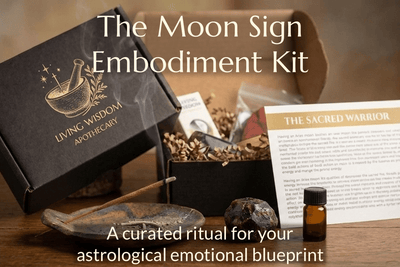
The Moon Sign Embodiment Kit is one such companion, designed to support the lunar dimension of this practice with sensory tools aligned to the emotional body's nourishment needs. Paired with your moon sign awareness, it offers a tangible way to bring the lunar check-in into the body rather than keeping it as an abstraction.
Where to Go Next: Deepening With Individual Placements
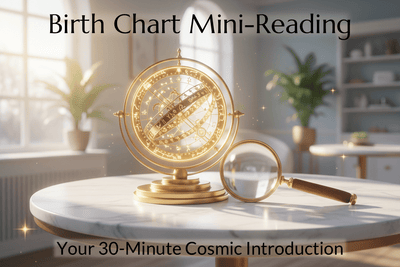
If you would like a personalised reading of how your specific Big Three interact, an Astrology Mini-Reading with Aleisha offers chart-specific insight into how your sun, moon, and rising are actually speaking to each other in your natal configuration. This is where the framework stops being general and starts being yours.