
There is a particular quality that settles into your hands the moment you reach for an object you have held through a hundred rituals. The weight of a smooth stone. The worn softness of a journal cover. The scent of an oil that has opened so many practices that your nervous system recognizes it before your mind does. These are not just objects. They are relationships. And building a personal ritual toolkit is, at its core, the act of choosing which relationships you want to cultivate in your practice.
This is different from curating a collection. A toolkit is organized by function and relationship: each object has a role, each role deepens through use, and the whole becomes greater than the sum of its parts. Whether you are new to ritual practice or are bringing more intentionality to your existing ritual supplies, this guide invites you to think about your tools as allies rather than accessories.
What Makes an Object a Ritual Tool
Nothing in a ritual toolkit is inherently sacred. A stone from any creek bed can become one of the most powerful grounding objects you own. A candle from a corner store can hold the same witnessing presence as one hand-poured with ceremonial care. What transforms an ordinary object into a ritual tool is not the object's inherent properties. It is the quality of attention and relationship you bring to it, consistently, over time.
The nervous system learns through repetition. When you use the same oil, light the same candle, or hold the same stone at the opening of every practice, the brain begins to associate that sensory input with the particular state you enter during ritual. The object becomes what researchers call a conditioned stimulus: a sensory signal that reliably triggers an associated neural and physiological state. The object holds the memory of every intentional encounter, becoming a state-anchor, a physical key that helps your nervous system find a familiar door.
This is also what we explore in the article on how objects become ritual tools through the quality of attention you bring to them. The short version: begin with attention, and the tool will grow into its role.
The Core Toolkit: Sacred Tools for Home Practice
When building a ritual kit, the question is not "what do I need to buy?" It is "what relationships do I want to begin?" Below is a curated minimum for ritual tools for beginners: five categories that together cover the most essential functions of a personal practice. One, held with real attention, is enough to start.
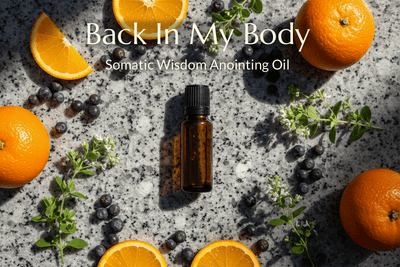
- An anointing oil or aromatic blend. Scent is the fastest path to the limbic system. Unlike most sensory inputs, olfactory signals travel directly to limbic structures without passing through the thalamic relay that filters other sensation. A scent used consistently in ritual can shift your state more quickly and reliably than almost any other cue. Choose your oil for elemental and somatic resonance, not only because it smells pleasant. an anointing oil chosen for somatic resonance becomes, over time, one of the most reliable anchors in your practice.
- A candle. Fire has held a witnessing role in ritual practice across nearly every human culture. Lighting a candle marks the threshold: the moment before is ordinary time, the moment after is practice time. Extinguishing the flame at the close marks the return. The candle does not need to be elaborate. It needs to be used consistently for this purpose.
- A journal. Not for journaling as therapy, though it may serve that function too. The ritual journal is an integration tool: a place to capture what arises in the body and mind during practice, before the ordinary mind reasserts its categories and narratives. Keep it near your practice space. Write in it immediately after, while the session is still present in your tissues.
- A grounding object. A stone, a crystal, a piece of wood or earth-grown material. Something with weight and texture that returns attention to the physical when the mind drifts. Many people find that holding something in the palm of the non-dominant hand during meditation or breathwork anchors the body in a way that supports deeper settling.
- Any other threshold marker. If you don't want to use a candle, there are many objects used consistently to open and close your practice: a bell, a rattle, a singing bowl, a specific breath sequence. The threshold marker signals to the nervous system that a container is opening and, later, that it is closing. This distinction between ordinary and ritual time is one of the most supportive structures you can build into a home practice.
These are the essential oils for ritual, the physical anchors, and the integrative tools that experienced practitioners tend to find indispensable. Begin with what calls to you, and trust that the rest will arrive when the practice is ready for them.
Botanical Allies: Plant Medicine as Living Toolkit
Plants are not products. They are presences. And when you bring botanical allies into your ritual practice, you are inviting living intelligence into the container.
Botanical allies take many forms: herbal teas prepared with intention before practice, bath soaks that work on the body while the mind quiets, tinctures held under the tongue at the opening of a session, smoke tools used to shift the atmosphere of a space. Each botanical carries specific elemental and somatic properties. Lavender quiets the nervous system through a different mechanism than cedar or frankincense. Rose shifts the emotional field differently than mint. These associations reflect centuries of careful observation, increasingly supported by research into phytochemistry and its effects on mood and physiology.
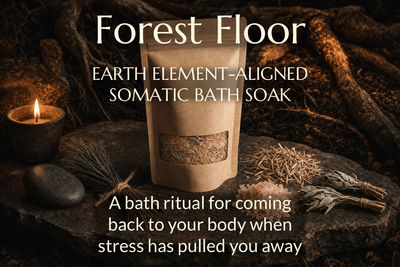
A bath soaking practice offers something few other ritual tools can match: full-body immersion in botanical medicine, with warmth supporting the parasympathetic nervous system while plants work through skin absorption and inhalation. a grounding somatic soak used before or after a ritual session may help consolidate what the practice opened, moving insight from the mental field into the body. Research into the anthropology of ritual consistently finds that aromatic plants and botanical preparations appear across virtually every tradition that uses ritual objects and ceremony. Their inclusion in your toolkit is less an invention and more a remembering.

Choosing Tools Aligned with Your Nature
One of the most useful frames for selecting ritual tools is the elemental system. Most contemplative traditions recognize that people tend toward particular elemental qualities, and that the most resonant tools will mirror and gently extend those qualities.
Earth
Earth-dominant people tend toward heavy, textural objects: dense stones, ceramic vessels, root-carved woods. Root-based botanicals and deep, resinous scents, vetiver, sandalwood, cedar, build the grounding and consolidation that Earth practice is built for.
Fire
Fire-dominant people often want bright candle flames and activating botanicals. Warming scents like cinnamon, frankincense, and black pepper resonate with Fire constitutions, as do tools that catalyze: courage, clarity, the willingness to begin.
Water
Water-dominant people tend toward fluid, smooth, reflective objects. Lunar-aligned botanicals and soft floral scents, rose, jasmine, ylang ylang, resonate with Water natures. Water rituals are often about emotional processing and the kind of knowing that arrives through feeling rather than analysis.
Air
Air-dominant people often gravitate toward light or feathered objects and clearing botanicals. Fresh scents, eucalyptus, mint, lemon verbena, feel most alive for Air constitutions. Air rituals often involve breathwork or movement practices that create space and clarity.
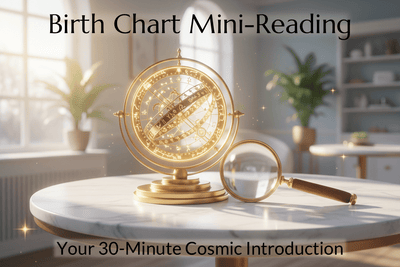
If you are uncertain of your elemental nature, the element ritual kits (the Earth Element Ritual Kit, and the Fire, Water, and Air versions) offer a thoughtfully assembled starting point for each. And if you want precise guidance on which tools and practices are most aligned with your chart, an Astrology Mini Reading can map your elemental constitution with specificity that general guidance cannot offer.
Building a Living Toolkit
A personal ritual toolkit is not built in one shopping trip. The real toolkit accumulates through practice: an object chosen when it calls to you, a botanical added when its properties are what the practice needs, a tool quietly retired when its season has passed. This is how to build a ritual kit that actually serves you: by letting it grow in response to lived experience.
Begin with one object. Something that feels right in the hand, that carries a scent or texture or weight you want to return to. Use it consistently, and let the rest arrive in its own time.
The act of setting the intention that activates your tools is part of the initiation of any new object into your practice. Before you use a new tool for the first time, consider holding it with full attention for a few quiet breaths and naming, inwardly or aloud, what role you are inviting it to play. It is the beginning of the neural encoding that will make the object a reliable anchor over time.
Caring for Your Tools
Objects used with consistent intention accumulate something. Whether you understand this energetically or neurologically, a ritual object in regular use is worth tending. Most traditions that work with sacred tools for home practice include some form of periodic cleansing and renewal.
Cleansing approaches vary. Common options include passing an object through smoke from a plant ally (cedar, rosemary, and palo santo are often used for this, with attention to responsible sourcing), resting objects in moonlight overnight, placing them briefly in a bowl of sea salt, or holding them with a clear intention to release what has accumulated. Charging a tool, preparing it for active use, often involves the inverse: holding it with intention as you clarify what you are asking it to hold, particularly at new or full moons when a sense of threshold is already present in the practice.
Retiring a tool is perhaps the least discussed and most important practice. When an object has served its season and no longer carries the same aliveness in your hands, it can be released with gratitude rather than guilt. Some people return objects to the earth, some pass them on, some place them on a dedicated shelf where they rest without active use. The relationship is acknowledged as it changes, with the same care at the close as at the beginning.
Your toolkit is, in the end, a set of allies: physical presences through which intention becomes embodied practice. The objects are how the Embodiment stage of integration becomes tangible. Insight that lives only in the mind has not yet completed its work, and your ritual tools are how that translation happens.
If you would like guidance on which tools and practices are most aligned with your chart, an Astrology Mini Reading is a natural next step: a personalized map of your elemental nature, your ritual rhythms, and the allies most likely to feel like home.