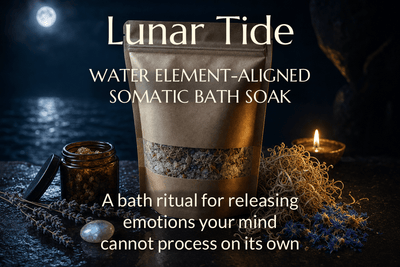

Notice what happens in the body the moment you walk into a bathroom lit only by a single candle. Before you have touched the water, before you have added anything to the tub, before you have even fully closed the door, something in the nervous system shifts. The shoulders drop a fraction. The exhale lengthens. This is not just ambiance. It is a sacred bath space doing exactly what it is designed to do: sending a signal to the body that a unique experience is about to begin.
Environmental psychology has established what the body already knows intuitively: the sensory qualities of a space are read by the nervous system as safety or activation signals before the thinking mind has registered a single opinion. The limbic system, which governs threat detection and emotional memory, processes environmental cues faster than the prefrontal cortex does. A ritual bath environment designed to send consistent "rest and safety" signals primes the body for deeper parasympathetic activation before a single drop of water touches the skin. The space is the first layer of the practice.
How the Environment Speaks to the Nervous System
Roger Ulrich's foundational research on biophilic design demonstrated that the sensory qualities of environments (light quality, sound level, visual complexity, and natural elements) directly influence stress physiology. Research published in environmental health journals has consistently found that spaces with lower complexity, warmer light, natural materials, and reduced auditory stimulation activate the parasympathetic nervous system more readily than high-stimulation environments do. The ritual bath environment applies this understanding in the most personal space available: the bathroom.
The three primary sensory levers available in any bathroom are light, sound, and scent. Each of these reaches the nervous system through a distinct pathway, and each can be deliberately oriented toward rest.
Light: The Most Powerful Signal Available
Overhead fluorescent or bright white LED lighting signals alertness and task performance. Its cool color temperature (5000K and above) is the same spectrum used in workplaces and hospitals to promote wakefulness and focus. This is precisely the wrong signal for a ritual bath. The simple act of switching off overhead lighting and replacing it with a single candle is the most effective single intervention available for shifting the body's read of the bath environment.
Candlelight's warm color temperature (approximately 1800-2000K) falls in the range evolutionarily associated with fire and shelter. For most of human prehistory, warmth and low firelight in an enclosed space meant safety: a place to rest, to gather, to be off duty from vigilance. The nervous system still carries this association. A candle is not romantic mood-setting; it is an ancestral safety signal. It speaks to a part of the body that predates language.
If candles are not possible in your space, a lamp with a warm-toned bulb at the lowest available setting can approximate this quality. The principle is less light, warmer light, contained light.
Sound: Protecting the Quiet
The bath is already one of the quieter environments in modern life. The goal of sound curation is to protect and deepen this quality rather than fill it. Research on music and the autonomic nervous system suggests that if music is used, slow tempo (60-80 beats per minute), minimal percussion, and primarily melodic or harmonic content offer the most parasympathetic support. Anything with lyrics engages the prefrontal cortex's language processing and works against full release. The sound of the water itself, filling the tub and then settling, is a natural nervous system anchor and needs no enhancement.
Silence, too, is a valid and often undervalued choice. Many people find the first few minutes of a silent bath uncomfortable: the mind rushes to fill it. This is the practice beginning. The discomfort of silence is often the first layer of held tension asking to move.

Building a Small Altar Beside the Bath
The concept of a bath-adjacent altar is simple: a small, intentional arrangement of objects placed on the tub ledge, a folded towel, or a shelf nearby. It need not be elaborate. A river stone. A candle. A small bottle of oil. A crystal. A single dried flower stem. These objects are not decorative. They are symbolic anchors that tell the nervous system, through a different channel, that this is a ritual space rather than a ordinary one.
The arrangement of these objects is itself part of the practice. The deliberate act of placing a stone, lighting a candle, setting out an oil before the bath is drawn is the ritual's true beginning. It marks a threshold: the moment of crossing from ordinary time into ritual time. Anthropologist Arnold van Gennep described this kind of threshold-marking as essential to the structure of ritual in every culture he studied: the separation from ordinary space precedes the transformative encounter.
A bath altar might include one or more of the following, chosen with intention rather than accumulation:
- A stone or crystal that carries a somatic quality you want to amplify: grounding, clarity, softening, strength. Hold it briefly before entering the water.
- A small bottle of oil or botanical soak as both a functional tool and a ritual object. The act of choosing and opening it is part of the ceremony.
- A single candle, placed where its light will reach the water. Generic taper candles, beeswax votives, or any candle with a warm, natural flame serve this purpose. The quality of the light matters more than the brand.
- A dried flower or botanical stem: a sprig of lavender, a rose, a small bundle of dried herbs. These carry scent and symbolism simultaneously.
- A written intention: a word or a short phrase on a small piece of paper, folded and placed at the altar's center. Some people burn this after the bath; others simply let it rest there.
For those who want to develop a fuller altar practice beyond the bath, more comprehensive guidance on how to build a ritual altar in any space is coming.
Scent as Environmental Preparation
The olfactory system is the only sensory pathway that connects directly to the limbic system without passing through the thalamus first. Every other sense is routed through the brain's central relay station before reaching emotional memory and threat-detection. Scent bypasses this relay entirely, which is why a particular smell can trigger memory, emotion, or physical response before the thinking mind has caught up.
This makes scent an unusually powerful tool for environmental preparation. Before the bath water is drawn, diffusing or introducing a single essential oil into the bathroom begins to prime the olfactory-limbic pathway for the context of rest. Lavender is the most well-researched in terms of its effects on the autonomic nervous system. Frankincense, sandalwood, rose, and vetiver each carry their own somatic qualities. Even a single drop of oil placed on a piece of cotton near the bath or on the floor of a shower fills the bathroom's small space quickly.
The scent pre-signals the body: this context has been established. By the time you enter the water, the nervous system has already begun the shift.
The Principle of Earned Restraint
One of the most common mistakes in building a ritual bath environment is overcrowding it. Too many candles, too many crystals, too many essential oils diffusing simultaneously, too many objects on the ledge. Abundance in a ritual space often functions more like visual noise than like sanctuary. Each additional element adds something for the nervous system to process, and what the nervous system most needs in a bath ritual is less to process, not more.
One candle is often better than five. A single stone chosen with care outweighs a collection assembled quickly. The Japanese concept of ma (the art of negative space, the quality of what is deliberately left empty) applies here. The spaces between objects, the quiet between sounds, the unoccupied surface beside the single stone: these are not absences. They are the container that allows the objects present to carry meaning.
The ritual bath environment does not need to be beautiful in a complicated way. It needs to be coherent. It needs to say, without words, that this is a different kind of time.
Beginning Tonight
None of this requires new equipment or elaborate preparation. The minimum effective ritual bath environment is: overhead light off, one candle lit, phone in another room. Everything else is an elaboration on that foundation.
For those ready to add sensory depth, LWA's elemental bath soaks are formulated to function as both botanical companions and environmental anchors. The scent and mineral quality of each blend works with the water and the space to deepen the sensory signal of each ritual. They pair naturally with the environment built here, completing the bath's sensory container.
Begin simply. The space is already closer to sacred than you think. It only needs a candle and your presence to deepen the experience.