
You have tried a ritual someone else swore by, and felt nothing. The guided meditation that left you more restless than before you sat down. The journaling practice that felt like a chore from the very first line. The sound bath a friend called life-changing, which you moved through politely, waiting for something to shift. These are not failures of practice, and they are not failures of you. They are mismatches. Knowing which rituals are right for you is the work of this article, and it begins with a surprisingly ancient question: what element are you made of?
The elemental system, developed across Ayurvedic medicine, classical Greek philosophy, and indigenous cosmologies, is not a personality quiz. It is a diagnostic tool: a way of reading the qualities already present in your body, your nervous system, and your emotional patterns. When you understand your elemental constitution, choosing a practice stops feeling like guesswork and starts feeling like recognition.
Why Ritual Fit Matters: The Nervous System as a Starting Point
Your nervous system is not a blank slate that any practice can write upon equally. It has its own texture, its own rhythms, its own deeply grooved patterns. Research in polyvagal theory and somatic psychology suggests that the practices most likely to support regulation are the ones that meet the nervous system where it already is, then gently invite it somewhere new. A practice that runs against the grain of your constitutional patterns may produce friction rather than ease.
This is why someone with strong Fire energy, already running hot and driven, may find that adding more activating practices to their day increases agitation rather than clarity. What their system often needs instead is the cooling weight of Earth: slow movement, physical grounding, the smell of soil or resin, the steadiness of something rooted. Conversely, an Earth-dominant person moving through a heavy, contracted season may need a spark of Fire or the spaciousness of Air to restore flow.
The elemental framework helps you recognize what your system actually needs, which can be quite different from what your habits suggest. If you are new to understanding what ritual is and why it works, that foundation is a useful place to begin.
The Four Elemental Constitutions: A Fluid Map, Not a Fixed Box
Before moving through each element, a note worth keeping close: very few people are purely one element. The constitutions below are tendencies, poles on a spectrum. You may recognize yourself strongly in one and find pieces of yourself scattered through the others. The goal is not to be labeled but to be seen, and to find language that helps you understand your own patterns with a little more precision.
Earth: The Body That Knows How to Stay
Earth-dominant constitutions carry a quality of presence, a groundedness that others often find immediately comforting. These are people who think before speaking, who feel most themselves when their feet are on actual ground, who experience time as something substantial rather than slippery. The body of an Earth person often moves slowly and deliberately: sensory-oriented, noticing texture, scent, temperature, the warmth of a bath, the rhythmic pressure of self-massage.
Earth sign rituals that resonate most deeply include herbal baths, body anointing with warm oils, nature contact (barefoot walking, gardening, sitting against a tree), and slow somatic movement. When Earth tips out of balance, it can feel like heaviness that will not lift, rigidity in thinking or routine, or a sweet inertia that gradually becomes stagnation. In these moments, Fire practices that invite activation or Air practices that bring breath and lightness into spaces that have grown too still offer the medicine.
Fire: The Body That Wants to Move Toward Something
Fire constitutions are easy to recognize by their quality of directedness: people who wake already reaching for the next thing, who feel most alive when engaged in something that matters, who bring warmth and intensity to whatever they touch. Physically, Fire people often run warm, prone to tension in the jaw and upper body. Their nervous systems tend toward activation and forward momentum. They are nourished by practices that honor that energy while giving it shape: candle work and fire gazing, vigorous movement, morning practices timed to the rising sun, active breathwork, any practice with clear intention and clear structure. Fire sign rituals work best when they channel rather than suppress this element's natural intensity; ceremony creates the container the Fire body genuinely needs.
Out of balance, Fire becomes combustion without direction: scattered, burning through energy faster than it replenishes, or exhausted in a way that paradoxically feels too activated for rest. Water offers the medicine here, with its emotional softening, lunar timing, and the cooling weight of water itself. Earth supports as well, inviting the body to sink rather than launch.
Water: The Body That Moves in Cycles
Water constitutions live close to the surface of feeling: intuitive, emotionally intelligent, attuned to the undercurrents in a room. They often experience time as cyclical rather than linear, moving through phases of openness and withdrawal. Physically, Water people may feel emotion as weight in the chest, fullness behind the eyes, a softness in the belly that responds quickly to the emotional field around them. They are nourished by lunar rituals, bath ceremonies, dream work, gentle somatic practices, and tinctures taken slowly. Water sign rituals often involve surrender rather than effort: releasing what has gathered, creating space for what is felt to move through rather than accumulate.
When Water tips into imbalance, it can feel like emotional flooding, a porousness where the edges of oneself become hard to locate. Earth offers containment here, the felt sense of a boundary between inside and outside. Air brings clarity and perspective, the breath that creates space inside a moment that has grown too dense.
Air: The Body That Thinks in Constellations
Air constitutions live largely in the realm of ideas, connection, and possibility: people who make unexpected conceptual leaps, find language easily, and feel energized by conversation and novelty. Their physical signature often involves lightness, quick movement, expressive hands, a tendency to breathe shallowly when absorbed in thought. They are nourished by breathwork (which makes the invisible act of breath visible and intentional), journaling, incense and aromatic practices, sound rituals, and movement with improvisational quality. Air sign rituals work best when they are not too fixed; a rigid structure often creates resistance in Air constitutions, while practices with room for inquiry and creative adaptation sustain engagement naturally.
Out of balance, Air can become a kind of spinning in the mind that never quite lands, with anxiety arising when thought is unmoored from sensation. Earth is the primary medicine here: physical grounding, slow movement, the weight of the body pressing into the floor. Water also supports, offering emotional depth and a quality of saturation that slows the mental currents.

Finding Your Elemental Signature
Your elemental constitution is not single-noted. Most people carry a blend of two dominant elements, with traces of the others woven through. The most accessible entry point is your astrological chart: specifically, the elements of your sun sign, moon sign, and rising sign.
The sun sign reflects your core vitality and the quality of energy you build toward. The moon sign describes your emotional body, the somatic instincts, the kind of nourishment your nervous system reaches for when depleted. The rising sign shapes how you move through the world. Together, these three placements give you a rough elemental map: if two or three fall in the same element, that element is likely dominant. If they are distributed across elements, your nature is more blended, which brings its own richness and its own complexity.
A practical place to begin: notice which element you are most naturally drawn toward in your reading, and also which one you find most foreign or challenging. Both carry information. The element that feels distant often represents a quality your system is quietly hungry for.
Notice also where you are right now, not just constitutionally but seasonally. Stress, life stage, and the relational field around you all shift the elemental picture. Someone with strong Earth in their chart may be moving through a Fire season of life, which means grounding practices become even more essential as a counterbalance. This is where how the Integration Cycle moves through different elemental expressions becomes relevant: your ritual practice is responsive, not static, and deepens as your understanding of your own patterns deepens.
Beyond Elements: The Deeper Map
The elemental framework is an entry point, genuinely useful and meaningfully precise, but it is also a simplification of a much more intricate system. Astrological tradition has long understood that the birth chart is a layered document, one that describes not only your constitution but the specific themes most alive in this season of your life.
The moon sign tells you something more specific than the sun sign about somatic and emotional needs. A person with a Scorpio sun (Water) and a Gemini moon (Air) experiences a more layered ritual landscape: their emotional body needs breath and language to process, while their core vitality needs depth and cyclical practice to feel replenished. The sun sign alone misses this.
Current transits add another layer still. The practices most supportive in a year of Saturnian contraction differ from those that serve a Jupiterian expansion. The body knows this intuitively, which is why a practice can feel suddenly inadequate even when nothing in your external life has changed. A full astrological reading navigates this terrain: not just who you are constitutionally, but what this season of your life is asking for.
An Invitation to Know Your Chart
The elemental guide above is a starting place: a way of developing language for your own ritual nature. It may already have clarified something, a recognition that one element's description felt like seeing yourself clearly, or that another's description of imbalance named something you have been quietly living.
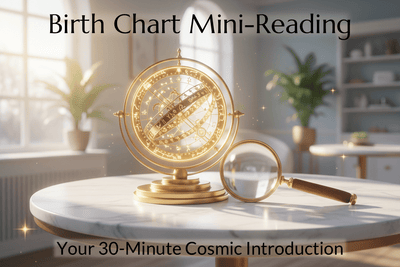
For those who want to move from the general map to the specific one, a personalized astrology reading is the most precise way to map your ritual nature. Rather than working from your sun sign alone, a reading draws on your full chart: the concentration of elements, the moon sign's emotional signature, the rising sign's somatic expression, and what the current transits are illuminating in your life right now. The result is not a prescription but a portrait, one that tends to make the question of which practice to choose feel suddenly far less mysterious.
This is Stage 2 work: the bridge between wanting a practice and knowing which practice is yours. If you have been moving through rituals by trial and error, that is a valid and even beautiful approach. There is also a more precise path available whenever you are ready for it.