
You have felt it without having a word for it: the specific quality of a January morning that asks you to stay still and go inward, or the way late March carries a restlessness in the chest that is closer to anticipation than anxiety. The way August heat settles into a fullness that is almost too much, and then October arrives with a particular sharpness in the air that feels like an invitation to let something go. These are not just weather patterns. They are elements through seasons, moving through the year in a cycle that the body already knows, whether or not the mind has a map for it.
Working with the elements seasonally is among the most accessible entry points into elemental practice: the year itself becomes your teacher, and what is being asked of you becomes legible through the lens of earth, fire, water, and air.
A Note on Elemental Assignments Across Traditions
Different wisdom traditions assign the elements to seasons differently, and it is worth naming this directly. In the Western classical tradition rooted in Greek philosophy, Spring corresponds to Air, Summer to Fire, Autumn to Earth, and Winter to Water. Traditional Chinese cosmology uses a five-element system that maps differently, with late summer as its own distinct Earth season. Ayurvedic frameworks assign seasonal influence according to dosha qualities, with Vata (Air and Space) rising in autumn, Pitta (Fire) peaking in summer, and Kapha (Earth and Water) dominant in late winter and early spring.
Comparative studies of seasonal spiritual traditions consistently show that while the specific correspondences vary, the underlying impulse is universal: human beings have always read elemental qualities in the turning year and calibrated their practices accordingly. At Living Wisdom Apothecary, rather than selecting one tradition's assignment as authoritative, we offer a synthesis that invites you to sense what each season is actually asking for in your own body and local landscape. Your experience is the primary text.
Spring and Air: Fresh Breath and New Beginnings
What Spring Feels Like in the Body
Spring arrives first in the lungs. Before the warmth is reliable, there is a different quality to the air itself: lighter, more electric, carrying the scent of soil beginning to breathe. Research on circadian biology suggests that lengthening daylight is closely tied to seasonal shifts in serotonin availability and alertness (Frontiers in Neuroendocrinology), which may be why spring often brings a spontaneous return of mental energy and creative impulse.
Spring is Air's season. The element of thought, communication, and possibility finds its mirror in the freshness of early spring, in the restlessness of a mind that suddenly wants to plan, to connect, to speak. Spring is a time for Air practices: breathwork that clears what accumulated over winter, journaling to articulate what is emerging, conversations that had been postponed.
Summer and Fire: Full Expression at the Height of the Year
Working With Fire's Peak
Summer is the season when life moves to the surface. The sun is overhead and insistent. Days feel longer and night comes later. There is a pressure toward visibility, toward bringing what has been germinating inside out into the heat and the light. This is Fire's season, the moment when will, vitality, and outward movement reach their peak.
Fire at its seasonal height invites commitment to projects begun in spring, bold action, and the body's own warmth through movement and the digestion of experience. This is also the season to notice whether Fire is tipping toward excess: the depletion of burnout often has its roots in summer, when cultural pressure to produce aligns with the element's own intensity.
Autumn and the Meeting of Earth and Water
Autumn is the most elementally complex season, which may be why it tends to produce the most layered emotional experience. In many Western traditions Autumn is assigned to Earth: the harvest, the settling, the acknowledgment of what has been grown and gathered. There is a heaviness and richness to early autumn that feels unmistakably earthy, the light dimming, the days contracting, a call toward structure and completion.
As autumn deepens, Water begins to enter. The rains return. The emotional quality shifts from the structured satisfaction of harvest toward something more interior and reflective: letting go of what did not grow, processing the complexity of endings, moving inward. Different traditions capture different parts of this movement by privileging one element over the other. The fuller picture holds both.
Autumn ritual may draw on Earth's stabilizing quality in the early weeks before gradually introducing Water's more releasing quality as the season deepens. Journaling, emotional release practices, and tending to what is being composted, in both literal and figurative senses, are well-suited to autumn's dual nature.
Winter and the Deep Rest of Earth and Water
Winter asks for something many people in contemporary life find genuinely difficult: not less productivity, exactly, but a different relationship to it. A slowing. A willingness to stay close to the root. In the Western classical tradition, Winter corresponds to Water: the depths, the unconscious, the dream life. In Ayurvedic framing, Kapha, the Earth-Water constitution, rises through winter, bringing heaviness and the impulse to rest. Both capture something real: Winter is simultaneously the season of deep root-tending (Earth) and of inner listening (Water).
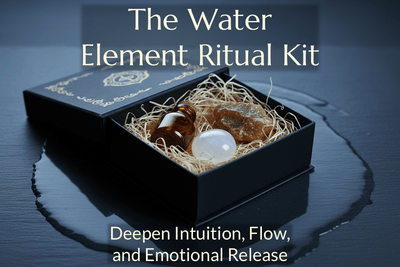
Ritual practice in winter tends toward the internal and the slow: body-weight practices that are warm and grounding, long candlelit baths, receptive journaling, working with root botanicals and warming spices. This is not a season for ambitious new practices. It is a season for tending what already exists and listening for what wants to emerge. The Sacred Ritual Kits collection includes earth-and-water-aligned tools well-suited to winter's contemplative quality.

Adapting Ritual Practice to Seasonal Shifts
Practical seasonal attunement does not require a complete ritual overhaul at each equinox. Small adjustments often carry more meaning than elaborate ceremonies. Consider which element the current season is amplifying, and whether that amplification is serving you or asking for counterbalance.
- If summer's Fire is burning too bright, introduce Water: more ritual bathing, more receptive listening.
- If winter's inward pull is tipping toward stagnation, invite a small dose of Fire: a candle ritual, an activating breath practice.
- If spring's Air energy is producing anxiety rather than clarity, anchor it with Earth: walking barefoot, working with stones.
- If autumn's dual pull between Earth's harvesting and Water's releasing feels disorienting, notice which you are resisting and offer a small ritual that honors the one being avoided.
The year's elemental cycle is an ongoing invitation to practice responsiveness rather than routine. The season does not require you to feel a particular way. It offers a particular quality of energy, and your practice is the art of meeting it honestly.
An Invitation to Track the Year
One of the most clarifying practices in elemental work is simple: spend one full seasonal cycle in deliberate observation. Notice, at each transition, what changes in the body first. Where does the new season land before the mind has processed it? What does the shift between Air's spring freshness and Fire's summer intensity feel like as a physical experience?
The elements are not a system to be memorized. They are a language the world is already speaking. The more fluent you become in that language, the more naturally your practice will align with what each season is actually offering.