
Something broke open. You may not have had a name for it at the time: standing at the rim of a canyon as the light went amber and the scale of things simply broke through every protective frame you carry, or lying in the dark at a ceremony that some part of you expected to write off, and instead finding that the walls came down and something vast and quiet moved through the room. You returned to your regular life afterward. You answered emails. You made coffee. But something was different, and you could feel it without being able to hold it. That is the territory the science of awe is beginning to map.
This article is for the person who had that experience and wants to understand what actually happened, not to reduce it, but to understand it well enough to meet it again with more intention.
Perceived Vastness and the Frame That Cannot Hold
In 2003, researchers Dacher Keltner and Jonathan Haidt published what has become a foundational framework for understanding the awe transcendent experience. They proposed that awe requires two things to occur simultaneously: perceived vastness (the encounter with something that exceeds your current frame of reference, whether physical, conceptual, or emotional) and a "need for accommodation" (the recognition that your existing mental structures cannot quite contain what you are perceiving).
Read that second condition again. Awe is not simply being impressed. It is the moment your mental frame becomes too small for what is arriving. The canyon is not just large. It is large in a way that your concept of "large" cannot absorb. The music does not just move you. It moves something you did not know could be moved. The ceremony opens something you did not know was closed. Keltner and Haidt's insight was that this cognitive disruption is not a side effect of awe. It is the mechanism. Awe is the nervous system's response to an experience that exceeds its current architecture, and the response is not alarm. It is the beginning of revision.
That revision has a somatic texture. Most people who have been in a genuine awe state describe a specific physical signature: a pause in the breath, a widening behind the sternum, a quality of stillness that is different from calm. Some describe chills that seem to move upward from the base of the spine. The body is doing something. And the question worth sitting with is: what?
The Neurological Signature of Awe: What Research Has Found
The Default Mode Network and the Quiet Self
Your brain has a network of regions that activates most strongly when you are not doing anything in particular. When you are spacing out, when you are planning, when you are ruminating, when you are rehearsing a conversation or reviewing your own behavior, these regions light up together. Neuroscientists call this the default mode network (DMN). It is, in a meaningful sense, the neurological home of the self-referential voice: the part of the mind that is always oriented around "I," "me," and "mine."
Research by Michiel van Elk and colleagues at the University of Amsterdam has examined what happens to the default mode network during awe neuroscience studies. Their fMRI findings suggest that awe is associated with a measurable decrease in DMN activity. The self-referential network quiets. The ruminating, planning, reviewing voice goes briefly offline, and something else becomes available in that opening.
This is a pattern that has been observed in other states as well. Researchers studying meditative absorption have noted similar decreases in DMN activity during deep meditation. Researchers examining flow states have observed comparable signatures. And investigators in the field of psychedelic-assisted therapy research, including work conducted at Johns Hopkins University and the University of Amsterdam, have documented DMN suppression as a consistent feature of the experiences they study. To be clear, this is a research observation about overlapping brain activity patterns across very different contexts. What it points to is that awe may be one of several natural pathways through which the nervous system can temporarily step out of its default self-referential mode and encounter something beyond the ordinary frame of the self.
That temporary stepping-out matters. When the DMN quiets, the qualities that ordinarily require effort, presence, connection, perspective, willingness to be changed, seem to become more available. The "small self," the compressed, anxious, habitual version of who we are, loosens its grip.
Awe Research and Inflammation: What Some Studies Have Noted
The effects of awe are not only neurological. Research reviewed by the John Templeton Foundation and others has examined whether awe states are associated with physiological changes beyond the brain. Some studies have reported that people who experience awe more frequently show lower markers of chronic inflammation, including cytokine profiles associated with long-term stress. The researchers involved are careful about causal claims, and the framing used is "may be associated with" rather than "causes." But the pattern is consistent enough to be worth noting: the awe inflammation research suggests that this state, which many people encounter only by accident, may have more biological relevance than its occasional nature implies.

The Small Self Effect: What Awe Does to the Social Body
One of the most reliably documented outcomes in awe research is something researchers call the "small self" effect. When people are induced into an awe state (in laboratory conditions, through exposure to vast natural imagery, or through reports of their own remembered experiences), they consistently show a specific shift: less preoccupation with personal concerns, more sense of connection to others, and greater willingness to behave generously without expectation of reciprocity.
This is not a trivial finding. What it suggests is that awe does something to the membrane between "me" and "everything else." The rigid boundary softens. The sense of the self as separate, bounded, needing to protect and manage and perform, temporarily relaxes. And in that relaxation, what researchers observe is more connection, more generosity, more openness to perspectives outside your own.
Keltner and his colleagues at the Greater Good Science Center at UC Berkeley have continued this research for two decades, documenting how exposure to awe, even brief exposure through video or nature, correlates with measurable shifts in social orientation. The nervous system, in awe, may be enacting something like ego softening: a temporary release from the compressed story of the self that makes genuine contact with the world briefly more possible.
For the purposes of understanding self-transcendence research, this is significant. Transcendence is often discussed as a mystical category, something that happens to rare people in exceptional circumstances. But what the research is pointing to is something more available: a state the nervous system can access, one that has physiological correlates, measurable effects, and that may be more invitational than accidental.
Ritual as a Deliberate Awe Invitation
Ceremony, Attention, and the Conditions That Open the Frame
If awe requires perceived vastness and the willingness to let the frame be too small, then ritual is a technology for creating the conditions in which that encounter becomes possible. Not guaranteed. Not manufactured. But invited.
The bath in the dark with a single candle is not theatrical. It is a deliberate removal of the ordinary sensory signals that keep the default mode network busy. The phone is not there. The to-do list is not visible. The body is warm and held and surrounded by scent. In that specific configuration, the nervous system can begin to let its ordinary vigilance relax, and when vigilance relaxes, the frame can begin to open.
The anointing under the full moon is not superstition. It is a practice that introduces your nervous system to scale: the scale of a sky that has been turning above human beings for longer than any of our concerns have existed. Touch and scent and cool air and presence brought to the fact of that vastness. These are awe spiritual experience invitations calibrated to the body, not the intellect. They bypass the part of the mind that argues and reach directly into the part that can encounter.
At Living Wisdom Apothecary, ceremony and ritual are designed with precisely this intention. Not as theatrical gesture, but as a carefully constructed opening: sensory elements chosen to quiet the familiar self, structural elements chosen to create a container of safety, and timing chosen to align with natural cycles that invite the awareness of scale. The science of ritual maps the neurological mechanism behind why these elements work together. Awe is the experience they are designed to make available.
The Problem with Accidental Awe
Most people who have had genuine awe experiences encountered them by accident: a landscape that was more beautiful than expected, a piece of music that arrived at the wrong moment and somehow became exactly right, a moment in ceremony that nobody planned. That is how most of us first know this territory.
But awe by accident is hard to return to. The experience passes, the ordinary mind closes back in, and the insight that was so vivid in the moment becomes difficult to access or integrate. This is one of the quiet functions of ritual: not to guarantee awe, but to create the conditions in which the ordinary frame has a chance to loosen, and to build a practice container that makes it possible to hold and return to what was accessed when it did.
The Integration Cycle is built around this understanding. Stage 1 is Awakening: the crack in the frame, the moment of first encounter with something larger. Awe is often the entry point. But research shows clearly that the insight available in an awe state is temporary without practice. The nervous system returns to its defaults. The DMN activates again. The small self reasserts. Stage 2 (Understanding) and Stage 3 (Embodiment) exist to give that first opening somewhere to land: to translate the experience into comprehension, and then from comprehension into a practiced, available way of being. Stage 4 (Integration) is where that practiced way of being becomes the new baseline, woven quietly into the texture of daily life.
Working with Awe as a Practice
What does it mean to take awe neuroscience seriously as a practitioner? It means understanding that the experience you have been calling "spiritual" has measurable neural correlates. It means recognizing that the moments when your ordinary self gets briefly interrupted are not distractions from practice: they are the practice, the raw material that ritual structures are designed to create conditions for.
It means understanding that scale matters, not as a philosophical concept but as a physiological one. Practices that genuinely introduce your nervous system to something larger than your current concerns, whether through natural environments, ceremony, breathwork, or specific sensory ritual, are doing real work on your default patterns. The more reliably you can create those conditions, the more available that opening becomes.
And it means understanding that integration matters as much as the opening itself. The awe state is not the destination. It is the door. Rituals designed for transition can support moving through what the awe state has opened, carrying the shift into ordinary life rather than leaving it behind at the canyon's edge.
The John Templeton Foundation has supported substantial research into awe and transcendence over the past decade, and the emerging picture is consistent: this is a real physiological state with real effects, accessible through deliberate practice, and worth building a relationship with over time.
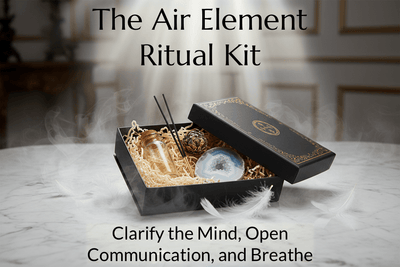
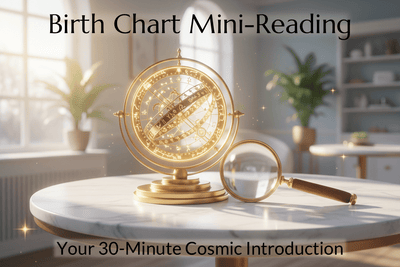
If you are curious what a structured, personalized entry point into this territory might look like for you specifically, consider exploring a personalized astrology mini-reading as a way to understand the cycles and openings already moving through your life. Or explore the Air Element Ritual Kit, designed to work with precisely the qualities of expansion, perspective, and breath that the science of awe suggests are the conditions in which frames can loosen and something larger can arrive.
Living Wisdom Apothecary products are ritual tools. They do not produce psychedelic effects and are not substitutes for therapy of any kind. The reference to psychedelic-assisted therapy research above is offered only as context for the overlapping neuroscience of awe, not as a recommendation for any substance or clinical protocol.