
You may have noticed that the longevity conversation has changed character in recent years. It has grown louder, more technical, and, in certain corners of the internet, almost feverish. Cold plunges and continuous glucose monitors and biological age tests. Sleep optimization protocols and supplement stacks calibrated to the millimeter. There is real science underneath much of this, and some of it is genuinely useful. But there is also, if you sit with the conversation long enough, a quiet absence at its center: the question of what the longer life would actually be for.
This article is about longevity meaning ritual as a linked system: the growing body of evidence connecting spiritual practice, felt purpose, and daily ritual to longer, healthier lives, and the older, deeper argument that the quantity of years was never quite the right question anyway.
What the Research Now Shows
Spirituality, Ritual, and Lifespan: The Emerging Science
A 2024 narrative review published in the National Institutes of Health database examined the relationship between spirituality, religiosity, and longevity across a substantial body of research. The review found that engagement with spiritual and religious practice was consistently associated with longer lifespan across multiple studies, with the relationship appearing to hold even after controlling for confounding variables like social connection, health behaviors, and pre-existing health status. As with all population-level research, the relationship is correlational rather than definitively causal, and individual variation is significant. But the pattern, across multiple populations and measurement approaches, is consistent enough to take seriously. The full review is available through PubMed Central for those who want to read the methodology and findings in full.
The proposed mechanisms are multiple, and they converge in interesting ways with what practitioners of ritual have always described from the inside: stress reduction, social cohesion, access to regular practices that organize the nervous system, and, perhaps most significantly, a coherent sense that one's life is embedded in something larger than personal circumstance.
Blue Zones and the Ritual Thread
The Blue Zones research, developed by National Geographic explorer Dan Buettner through decades of fieldwork in the world's longest-lived populations, arrived at a remarkably similar picture from a different direction. In Sardinia, Okinawa, Ikaria, Loma Linda, and the Nicoya Peninsula, longevity was not the product of any single factor but of an interlocking system: strong social bonds, daily movement woven into ordinary life rather than extracted as "exercise," plant-rich diets eaten in community, and, in every population, some form of spiritual practice or felt sense of participation in something larger. The Blue Zones project has documented these patterns across decades of fieldwork.
The Okinawan concept of ikigai, often translated as "reason for being" or "reason to wake up in the morning," is perhaps the Blue Zones finding that most resists being operationalized into a protocol. It is not a goal-setting framework. It is a felt orientation: the sense that one's particular existence is purposeful, that there is something the world receives from you being on this earth. The people who carried ikigai most vividly in Buettner's research were not necessarily the most accomplished. They were, more often, the most embedded: in community, in daily practice, in a sense of contributing to something that extended beyond their own comfort.
These findings connect directly to what the article on bio-spiritual health describes as the integration of body and soul in daily life. Longevity, in the Blue Zones data, is not a separate project from living well. It is the outcome of living in a particular way, a way organized around relationship, purpose, and practice.

Stress, Ritual, and the Biology of Aging
Why Chronic Stress May Age You Faster
The biological mechanism connecting stress to accelerated aging is now well enough understood to name carefully. Chronic stress generates what researchers call allostatic load: the cumulative wear on physiological systems from sustained activation of the stress response. Over time, this load is associated with shorter telomere length, elevated inflammatory markers, dysregulation of cortisol rhythms, and impaired cardiovascular function. These are not metaphors for feeling worn out. They are measurable biological changes.
Ritual's relevance here is not that it "cures" stress-related aging, but that consistent practices which lower cortisol, support heart rate variability, and create regular windows of parasympathetic recovery may, over years and decades, reduce the cumulative biological cost of living in a demanding world. The emphasis belongs on "may" and "over time." This is not a promise. It is a reasonable biological inference from what we understand about allostatic load, HRV, and the physiology of recovery.
The article on heart rate variability and spiritual practice explores the HRV dimension in depth. HRV, the variation in timing between heartbeats, is among the most sensitive available markers of the nervous system's capacity for flexible regulation. Higher HRV is associated with biological resilience in ways that connect meaningfully to longevity spirituality research: it appears to be something that consistent, intentional practice can actually move over time, in the direction of greater health.
The Ritual Health Benefits: A Daily Practice That Compounds
What is notable about the lifestyle patterns in long-lived populations is not that any single element is miraculous. It is that ordinary, repeated practices, done daily or near-daily over decades, appear to produce outcomes that no single intervention could replicate. This is the Earth element's particular wisdom: slow, patient, consistent, rooted. The Earth element governs the long arc, the gradual accumulation, the deep-rootedness that only time and repetition can build.
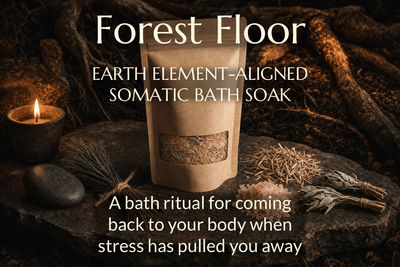
A daily ritual practice, even a brief one, participates in this kind of compounding. Not dramatically. Not in ways you will see in a single week. But in the way a tree's rings accumulate: quietly, steadily, in response to the actual conditions of the seasons. The Somatic Grounding Soak (Earth Element) was designed specifically to support this quality of practice: a grounded, sensory daily anchor that tells the body, in its own language, that there is time, that the earth holds, that the roots are real.
The Meaning Dimension: What the Spreadsheet Cannot Measure
Viktor Frankl and the Primacy of Purpose
Viktor Frankl, the Viennese psychiatrist who survived Auschwitz and three other Nazi concentration camps, observed in the extremity of those conditions something that his entire subsequent career elaborated: that survival was not primarily a function of physical strength or even luck, but often of the capacity to find or sustain meaning in the situation. Those who maintained a sense that their existence was purposeful, that something awaited them beyond the camp, that they had something still to contribute, seemed to carry a quality of psychological endurance that did not correlate neatly with physical health. Frankl's account in Man's Search for Meaning is not a controlled study. But as a phenomenological observation from inside conditions of extreme deprivation, it carries a particular kind of weight.
The larger argument Frankl spent his career making is this: meaning is not a luxury. It is a biological necessity. Its absence does not merely make life feel less worthwhile. It produces what Frankl called an existential vacuum, a pervasive sense of futility that has downstream effects on motivation, health behavior, social connection, and the immune system's capacity to function. The spiritual longevity case rests partly here: that meaning is not the decorative layer atop a properly optimized physical body, but a foundational condition for that body's long-term function.
Lunar Cycles, Seasonal Rhythms, and Daily Meaning Practice
One of the quieter gifts of ritual practice organized around natural cycles is what it does to the felt sense of temporal meaning. When you mark the new moon with intention, follow the seasonal wheel through its eight stations, track the transits of your natal chart through the year, you become a participant in patterns larger than the arc of your individual concerns. This participation is not pretend. The lunar cycle is real. The seasons are real. Your chart's transits describe genuinely different qualities of time. Engaging these rhythms as a daily meaning practice builds something the meaning purpose lifespan research gestures toward: the felt sense that one's life is not merely happening to you, but is part of a coherent, larger pattern that deserves your presence.
The person who knows they are in a Saturn transit is meeting that difficulty differently than the person who experiences the same difficulty as random misfortune. The person who marks the autumn equinox with a grounding practice is receiving a seasonal invitation to reflect on what needs to be released before winter. These are small acts of meaning-making, repeated across years, that build a fundamentally different relationship to the passage of time.
Reframing Longevity as a Spiritual Orientation
More Presence, Not More Years
There is a way to hold the longevity question that shifts it from a project of accumulation to one of depth. Not more years, but more presence in the years available. Not a longer resume of experiences, but a greater capacity to actually inhabit the ones that come. The blue zones ritual thread, the research on purpose and lifespan, the spirituality-longevity correlations, these may all be pointing toward the same underlying phenomenon: that the nervous system, properly tended, properly connected, properly rooted in purpose and practice, functions differently over time. Not just longer. Better. More available to experience. More resilient in difficulty. More capable of genuine rest.
This is what the Earth element teaches in its patient way: the tree that lives for centuries is not the one that grew fastest. It is the one whose roots went deepest, whose growth was steady, whose relationship to the ground beneath it was constant and real.
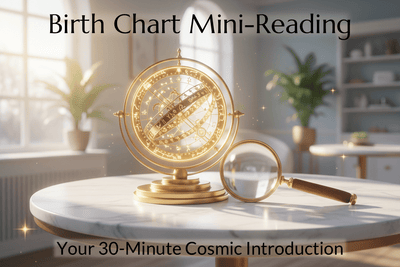
If you are drawn to exploring what a daily meaning practice might look like for your particular life, a personalized astrology mini-reading can offer a precisely mapped starting point: a language for the rhythms already moving through your year, the places where purpose is available, the practices that tend to work for the way your particular nervous system is organized. Not as prediction, but as a map for the territory you are already in.
Longevity, at its deepest, is not something you can hack. It is something you can grow into, one rooted day at a time.