
Pick up any object near you right now and hold it for a moment. If it belongs to someone you love, or was present at a defining moment in your life, you may feel something shift in your chest: a warmth, a slight heaviness, a quality of attention that the object calls forth. That response is not sentiment. It is a genuine somatic and neurological phenomenon, one that points to something fundamental about what sacred objects altar practice actually is. The object carries something real. The question is what, and how to work with it honestly.
This article explores the principles behind choosing altar objects and consecrating them, drawing on anthropological frameworks, neuroscience, and the lived traditions of multiple cultures.
What Makes an Object Sacred
The sociologist Emile Durkheim, in his foundational work on religious life, drew the defining distinction between the sacred and the profane. The sacred is not a quality inherent in an object. It is a quality conferred by the collective or individual attention, by the act of setting something apart from ordinary use and ordinary meaning, by the intention with which an object is held and handled. A stone from a riverbank and a stone from a crystal shop are mineralogically identical. What distinguishes them on an altar is what has been brought to them, and what has accumulated in them through use.
This is not a diminishment of sacred objects. It is, if anything, a more empowering framework. It means that the process of consecration is genuinely generative: attention and intention, consistently applied, transform an object. It also means that an elaborate or expensive object is not inherently more potent than a simple one. What gives altar objects genuine weight is not their appearance or their price. It is their history.
The Two Sources of Potency
Altar objects draw their weight from two primary sources, which often overlap. The first is lived history: the object that belonged to a grandmother, was given by a teacher at a pivotal moment, was found on a walk during a significant passage, or was present when something changed. These objects carry somatic weight because they carry associated memory. When you hold them, the brain reinstates something of the state in which the memory was formed. The object is a context-dependent cue, not a metaphor.
Research on tactile experience and autonomic regulation, including work by Eckstein et al. (2020) on the calming effects of touch, confirms that the hand's contact with familiar, weighted objects produces measurable shifts in the autonomic nervous system. This is the mechanism behind the instinct to hold something meaningful when you need grounding: contact with a known object activates the same neural pathways as other tactile forms of regulation.
The second source is natural resonance: the inherent qualities of matter. Crystal structures, plant materials, metals, and organic compounds each carry physical properties that produce consistent sensory experiences. A piece of raw obsidian is cold, glassy, heavy, and dark. A dried bundle of lavender is fragrant and fragile. These qualities are real, not imagined, and they produce real effects in a nervous system that encounters them. The ritual traditions that have used these materials for centuries were tracking something genuine, even if the explanatory frameworks differed.
The Sourcing Principle: How to Find Your Altar Objects
The most common mistake in building an altar is prioritizing appearance over meaning. The spiritual marketplace offers beautiful objects in abundance. Many of them will never earn genuine altar weight, not because they are inferior objects, but because they carry no history and have been given no attention.
One stone found on a meaningful walk carries more altar power than a shelf of purchased crystals, because the found stone carries an event: the day, the light, the state you were in, the question you were carrying. Every time you pick it up, that context is partially reinstated. The purchased stone, given no such history, is still waiting to become an altar object in the truest sense.
Found objects from nature carry specific weight precisely because the act of finding them is a complete event. Gifted objects carry relational weight: the relationship is encoded in the object. Purchased objects are entirely neutral at the point of acquisition, which means they require active consecration to become genuinely anchored. This is not a reason to avoid purchasing objects for ritual use. It is simply an honest account of what the process involves.
The Criteria for Earning a Place
A useful question to bring to any potential altar object: does this object carry something I want to be reminded of? Not "does this look beautiful" or "is this the right crystal for my intention," but: does holding this object, in this moment, bring something forward that I want present in my practice? If the answer is yes, the object belongs. If the answer is not yet, perhaps it is waiting for its history to accumulate.
Categories of Altar Objects and Their Qualities
Different classes of objects carry different qualities of weight on the altar. Understanding these categories can help you build an altar that is genuinely layered rather than merely decorated.
Stones and Crystals: The Stabilizing Anchor
Stone carries the quality of deep time. A river stone is millions of years old. Holding it, the nervous system registers something that is slower and more patient than any human concern. This is not metaphor: the haptic experience of cold, heavy, smooth stone produces a specific somatic quality that many people find grounding and settling.
Plant Materials: The Living and Dying Anchor
Dried botanicals, resins, seeds, and bark carry the olfactory and visual signals of living systems. They decay, shift color, release scent as they age. This temporal quality is part of their altar value: plant materials bring the altar into relationship with seasonal and cyclical time. When a dried flower crumbles or a resin loses its scent, this is a natural cue to renew. Plant materials belong on the altar for a season, not indefinitely.
Personal Objects: The Identity Anchor
Objects from your own history, photographs, letters, a worn key, a piece of cloth from a significant garment, carry the richest context-dependent memory associations of any altar category. They do not need to be beautiful. They need to carry something true about who you are and where you have been. The altar is not a display. It is a record.
Devotional Objects: The Lineage Anchor
If you practice within a tradition, objects that belong to that tradition, a mala, a rosary, a statue, a prayer card, carry collective weight as well as personal weight. They connect your practice to a lineage of practitioners who have used the same forms. Hold these with specific respect for the tradition they come from, and be thoughtful about using objects from traditions that are not your own.

Consecrating an Altar Object: A Complete Practice
Consecration is the act of deliberately setting an object apart, of bringing conscious intention to it so that it becomes, in Durkheim's terms, sacred rather than profane. Traditions of consecration appear across cultures: in Hoodoo practice, an object may be washed, dressed with oil, and spoken to directly. In Hindu puja, the prana pratishtha ceremony breathes life into a statue through mantra, breath, and touch. In Celtic folk practice, an object might be passed through smoke, buried briefly in earth, or left under moonlight. The specific methods vary. The underlying structure is consistent: cleanse, declare, and activate.
The following practice draws on these shared principles. It is a suggestion, not a requirement. You might adapt it to match your own practice tradition and the specific quality of the object you are working with.
Step One: Cleansing
Hold the object in both hands. You might notice the weight of it, the temperature, the texture. Consider what you want to clear: any history that is not yours, any associations that do not belong to its new purpose. Choose a cleansing method that fits the object and your practice. Passing the object through smoke, with good ventilation and a heatproof dish nearby for any ash, is appropriate for most materials. Salt works for some objects but not all: selenite and soft stones should not be submerged in water or salt. Place the object where you feel its history can settle.
Step Two: Declaration
Hold the object again and speak its purpose. This does not need to be elaborate. "This stone holds the quality of patience. Every time I touch it at the altar, I return to that quality." The declaration is the moment of intention-setting. It is also, in neurological terms, the moment of beginning the context-dependent memory encoding. You are telling the brain what to associate with the object.
The neuroscience of placebo and expectation, explored thoroughly by Wager and Atlas (2015) in their work on the neural mechanisms of placebo effects, shows that the expectation and meaning a person brings to a treatment or object shapes the genuine neurophysiological response. The declaration is not performance. It is the construction of a functional expectation that will shape every subsequent encounter with the object.
Step Three: Activation
Place the object on the altar for the first time. Light a candle in a heatproof holder. You might sit with the altar for a few minutes, simply letting the nervous system register the new presence. You might write a single sentence in a journal about what this object is there to hold. The activation is the moment of integration: the object, the altar context, the declared intention, and the sensory anchor of light and perhaps scent, all associating together in the nervous system's memory.
When to Remove an Object
Objects are not permanent altar residents. They complete their purpose, lose their charge through habituation, or simply no longer carry the quality they once did. The practice of tending an altar includes the practice of releasing objects with the same care used in welcoming them.
When an object no longer produces the quality of attention it once did, consider returning it to the natural world (a found stone might go back to earth or water), passing it to someone for whom it carries meaning, or wrapping it and setting it aside. A brief acknowledgment, spoken or written, "Thank you for what you held," closes the relationship cleanly. This is not sentiment. It is good altar practice, and it prevents the accumulation of dead weight that dulls the whole space.
Finding Your Objects
The most useful altar is one you build slowly, with attention and patience, from objects that carry genuine weight. If you are beginning and your altar feels sparse, that is exactly right. One candle, one stone, one object from your history: this is a complete altar. Let it grow through finding and through practice, not through purchasing.
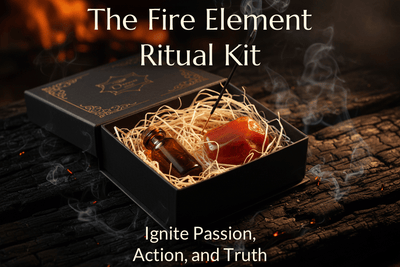
For the ritual tools that accompany this kind of dedicated, sensory practice, consider the . The Fire Element Ritual Kit offers incense and botanical grounding that makes each return to the altar a sensory event the nervous system can recognize and respond to. Both are tools for a practice you are building, not objects to collect.