
You know the feeling. You attended the workshop, bought the book, had the session that cracked something open, and for a week or two something was genuinely different. Then, almost imperceptibly, the old circuitry reasserted itself. Three weeks later you were back in the familiar place, wondering what happened to the person who had that insight. This is the central question of neuroplasticity ritual practice: why does understanding alone so rarely produce lasting change, and what does?
The answer is neurological, and once you understand it, the whole endeavor becomes far less mysterious. Lasting change in how the brain responds requires more than insight. It requires a particular quality of repeated, embodied, intentional practice that actually reshapes neural architecture. Ritual, understood correctly, is precisely that kind of practice.
How the Brain Actually Changes
The Biology of Neural Reorganization
Neuroplasticity is the brain's capacity to reorganize itself by forming new neural connections, strengthening existing ones, and pruning pathways that are no longer in active use. This is a structural biological process, not a metaphor. When you learn a new skill, navigate an unfamiliar environment, or repeatedly engage in a new behavior, the physical architecture of your brain changes: myelin sheaths thicken around active pathways, synaptic connections strengthen, and the regions most involved in the activity may actually increase in gray matter density over time. The research establishing these mechanisms, including foundational work available through NIH StatPearls on neuroplasticity, makes clear that this capacity for reorganization continues throughout the lifespan. The brain you have now is not fixed. It is a living structure in ongoing response to how you use it.
The critical variable, and this is where neuroplasticity ritual diverges from rote habit, is not frequency of repetition alone. It is the combination of intentional attention, emotional salience, and repeated behavior. Research on the behavioral conditions that drive neuroplasticity points consistently in one direction: the interventions most reliably associated with meaningful neural change share this quality of engaging not only behavioral repetition, but conscious, emotionally resonant participation. The brain's change mechanisms are activated more powerfully by practices that carry meaning, that engage the emotional and attentional systems simultaneously, than by the same behaviors performed on autopilot.
The Mistake Loop and Why Imperfect Practice Is Neurologically Necessary
One of the more counterintuitive findings in neuroplasticity research is the role of micro-failures in the change process. When the brain encounters a moment where an established pattern produces an outcome that does not match expectation, a neural correction signal fires. The system notices that something is not working as predicted and flags the moment for adjustment. This error-detection and correction loop is one of the primary mechanisms through which the brain updates its operating patterns.
For ritual practice, this means something practically important: a practice performed imperfectly, with full presence to the imperfection, may produce more lasting neural change than the same practice performed on automatic. The moment you notice you have drifted during your morning ritual, take a breath, and return, that return is a neurological event. The brain is doing its reorganization work right there. This is not a reason to be careless. It is a reason to release the expectation that meaningful practice must be flawless, and to understand that the practice of returning, again and again, is in itself the work.

Habit Versus Ritual: What Intention Actually Does
The Casper ter Kuile Distinction
Casper ter Kuile, in his careful exploration of ritual in contemporary life, names a distinction that is both simple and consequential: intentionality is what transforms ordinary repetition into something the nervous system receives as meaningful. Without intention, lighting a candle is lighting a candle. The act moves through the motor cortex, completes, and is filed with the thousands of other automatic behaviors of the day. With intention, something structurally different happens. The prefrontal cortex remains engaged alongside the automatic systems. The limbic system registers the act as emotionally significant. Attentional resources are directed rather than scattered. The dual encoding that distinguishes a ritual from a habit, the motor sequence registered simultaneously as a meaningful experience, is activated.
This distinction has direct implications for how you practice. The brain change intentional practice literature is not describing elaborate ceremonies or unusual materials. It is describing any repeated behavior that you enter with conscious presence and genuine care. The simplest practice, performed with full attention and real meaning, will build more durable neural architecture than a sophisticated practice run on autopilot. The neuroscience of ritual explored in the article on the science behind ritual practice grounds this dynamic in detail.
Ritual Brain Rewiring: What Is Actually Happening Over Time
As a ritual practice deepens across weeks and months, several converging changes become available. The neural pathways associated with the practice become more myelinated, meaning the signals travel faster and with less effort. The emotional associations encoded during earlier repetitions become more accessible: the practitioner does not have to work as hard to arrive at the state the practice supports; the nervous system has learned what this sequence means and begins to respond before the practice is even complete. What was effortful becomes available. What was available becomes, eventually, a kind of ground.
This is the Fire element's domain: directed will, activation, the conscious decision to bring full attention to the act of change. The deliberate practice neuroplasticity research is, in a certain light, a scientific description of what the Fire element has always asked of us: not frantic energy, not forceful pushing, but the focused, sustained, intentional application of attention to the direction we have chosen.
The Connection to Embodiment and Stage 3
Neuroplasticity Delivered Through the Body
In the deeper framework of the living wisdom integration cycle explored in the Integration Cycle deep dive, Stage 3, Embodiment, is where the insight that has been understood cognitively finally moves into the body's own knowing. This is not a metaphor. It is a description of a neurological process: the cortical understanding of Stage 2 needs to be encoded in the limbic system through sensory, somatic experience if it is to become something the body carries rather than merely something the mind has noted.
Embodiment practices, whether somatic movement, breathwork, ritual bathing, or the intentional use of plant-based sensory material, are directed brain healing ritual delivered through the body's own channels. The olfactory system's direct pathway to the limbic system, the vagus nerve's response to slow rhythmic movement, the cardiovascular coherence available through extended intentional breathing: these are the nervous system's native language. Ritual that engages them is not supplementary to the change process. It is the change process, operating through the substrate where change actually occurs.
Sensory Consistency as Neural Instruction
The sensory consistency of a well-designed ritual, the same scent, the same quality of light, the same sequence of movement, repeated across many sessions, is doing specific neurological work. Each repetition deepens the associative encoding. Each return to the practice reinforces the neural architecture that the practice has begun to build. Over time, the sensory elements themselves become access points: the scent of a particular herb, the feeling of a warm bath, the quality of silence that follows a bell strike each carry the accumulated meaning of every previous practice. The neuroplasticity habits the research describes are built, brick by carefully placed brick, from this kind of sensory repetition held inside an intentional frame.
A Practice to Begin Today
One simple invitation, for those who want to begin: consider choosing a single moment in your daily routine that you will enter differently this week. Not a new behavior, necessarily, but an existing one met with genuine presence. It might be the first cup of tea in the morning, a few minutes of intentional stillness before opening a screen, or the act of washing your hands as a small chosen return to the body. Before you begin, pause for one full breath and name, internally, what you are choosing. During, let your attention actually land in the sensory experience: warmth, weight, smell, texture. When your attention drifts, return without self-criticism. That return is the practice.
Done daily, for weeks, this small act builds something real. The brain does not require a ceremony. It requires attention, repetition, and meaning. You already have all three available.
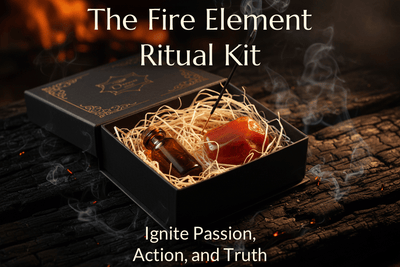
If you are ready to extend this into a fuller sensory practice, the Fire Element Ritual Kit offers a structured somatic framework for this kind of directed, intentional practice: a set of tools and invitations designed around activation, will, and the conscious engagement of the change process. The Heart Coherence Somatic Soak (Fire Element) is also a natural companion here, supporting the nervous system state from which intentional practice is most deeply available.
The brain is always changing. The question the neuroplasticity research is asking, in its precise and careful way, is the same question ritual has always asked: toward what, and with how much presence, are you directing that change?