
You have felt it before the words came. The belly tightening before a hard conversation. The inexplicable nausea that arrives with dread. Long before you could articulate what was wrong, your gut already knew. Ancient healing traditions placed emotional intelligence there, in the belly, in the solar plexus, in what Ayurveda called the seat of the fire and what Chinese medicine called the middle burner. The gut-brain-spirit axis is not a new concept. It is one of the oldest maps of human experience, recently confirmed by a very young science.
What neuroscience has begun to document in the past two decades is a communication network of staggering complexity connecting the digestive system to the central nervous system, to the immune system, and to the emotional and cognitive centers of the brain. This network runs in both directions. Your brain shapes your gut, and your gut shapes your brain. And at the center of that network, participating in ways researchers are only beginning to understand, lives a vast community of living organisms: your gut microbiome.
Understanding this system, even in broad strokes, can change how you relate to the physical sensations that arrive before thought does. It can also change how you understand the ancient human practice of using plant medicine as ritual support for the whole person, body and spirit held together in one coherent system.
The Architecture of the Gut-Brain Axis
A Bidirectional Conversation
The gut-brain axis describes the bidirectional communication between the digestive system and the central nervous system. This communication travels through several pathways simultaneously: the vagus nerve (a long, wandering nerve that carries signals between the brainstem and nearly every major organ in the body), neurotransmitters produced in the gut, immune signaling molecules, and the metabolic activity of gut bacteria themselves.
One of the most striking findings in this field is where serotonin is made. Serotonin is often described as a brain chemical involved in mood, but approximately 95 percent of the body's serotonin is produced not in the brain, but in the gut. Johns Hopkins researchers studying the gut-brain connection have described the gut as a kind of "second brain," one equipped with its own nervous system (the enteric nervous system), its own neurotransmitter production, and the capacity to send signals upstream to the brain via the vagus nerve without waiting for instructions from above.
This upstream communication is worth pausing on. The gut is not simply a passive receiver of messages from the brain. It is an active participant in the conversation, and in some cases it may be the one setting the tone.
The Vagus Nerve as Messenger
The vagus nerve is the primary physical channel through which gut and brain exchange information. It runs from the brainstem down through the heart and lungs and into the abdominal cavity, making contact with the gut along the way. About 80 to 90 percent of the nerve fibers in the vagus nerve carry signals upward, from body to brain, rather than downward. The nervous system is listening to the gut more than it is instructing it.
For those familiar with polyvagal theory and the vagus nerve's role in nervous system regulation, this architecture adds another layer of understanding. A gut that is inflamed, dysregulated, or in chronic distress is sending those distress signals upward through the vagus nerve continuously. What arrives at the brain is not neutral data. It is a physiological report on the state of the internal environment, and that report shapes mood, cognition, reactivity, and the capacity for connection and ease.
The Microbiome as Mood Architecture
Inside the gut lives a community of trillions of microorganisms, bacteria, fungi, viruses, and other organisms that collectively make up the gut microbiome. This community is not a passive resident. It is metabolically active, producing neurotransmitters (including precursors to serotonin and GABA), regulating immune responses, synthesizing vitamins, and communicating with the enteric nervous system continuously.
Research suggests that the composition and diversity of the gut microbiome is meaningfully associated with brain function and emotional experience. A disrupted or depleted microbiome, what researchers call dysbiosis, has been associated with elevated inflammatory markers, altered neurotransmitter activity, and changes in how the nervous system processes stress. Studies in this area have consistently found correlations between gut microbial health and emotional wellbeing, though the field is still working out the precise mechanisms and directions of causality.
What is clear is that the microbiome is not separate from mental and emotional health. It is part of the same system. Nourishing gut health is, in a very literal sense, participating in the conditions that support emotional regulation and cognitive resilience.

Plant Medicine, the Microbiome, and the Spiritual Dimension
What Ancient Traditions Were Doing
Across healing traditions, plants have been used as allies not just for the body but for the spirit. Ayurvedic preparations include digestive herbs like triphala, ashwagandha, and ginger as central elements of emotional and spiritual support. Traditional Chinese medicine's tonics for the shen (spirit) frequently work through the digestive system. Indigenous ceremonial plant use has long understood that plants work through the body first, that ingestion is a form of communication, and that the gut is the first point of contact between the plant's intelligence and the human system it enters.
What these traditions understood without the vocabulary of neuroscience was that the gut is a sensory and spiritual organ, not merely a digestive one. Consuming a plant preparation with intention was understood to engage the whole system: body, mind, and spirit at once.
Plant Medicine Microbiome Research
Modern research is beginning to examine what happens when plants and the gut microbiome interact. A 2022 systematic review published in Nutrients (PMC9144835) examined the relationship between medicinal plants and the gut microbiome in the context of mental health. The review found that certain plant compounds, including polyphenols, prebiotics, and fermented plant preparations, may support microbial diversity and the gut's capacity to produce and regulate neurotransmitters. The research framed plant medicine not as a direct psychiatric intervention, but as a way of supporting the ecological conditions in which the gut-brain communication system can function well.
This framing matters. It is not that a tincture of ashwagandha or a cup of tulsi tea rewires the brain directly. It is that plant allies, used consistently and with care, may support the living community in the gut that is already participating in your emotional and cognitive life. The mechanism is ecological. The intervention is relational. You are not taking a compound that overrides a system; you are offering nourishment to a community that is part of you.
Ritual Consumption as a Dual-Pathway Practice
There is something else worth considering about the practice of taking plant medicine with intention. When you prepare a tincture slowly, hold the bottle in your hands for a moment, set an intention for what you are offering your body, and take it with attention rather than in a hurry over the sink, two pathways are activated simultaneously.
The first is physiological. The plant compounds begin their work in the gut, interacting with the microbiome, triggering vagal signaling, contributing to the gut's neurotransmitter environment.
The second is symbolic and neural. The prefrontal cortex, the part of the brain most involved in meaning-making, intention, and the integration of experience, registers that this is a significant act. Not a habit to be run automatically, but a chosen, deliberate engagement. As explored in what it means to approach health as a bio-spiritual practice, meaning-making and physiology are not separate processes. They are concurrent, and they reinforce each other.
When both pathways are engaged at once, the ritual of plant medicine consumption becomes something more than supplementation. It becomes a full-system signal: to the gut, to the microbiome, to the vagus nerve, to the prefrontal cortex. The body receives the plant, and the whole person receives the intention.
Working With the Gut-Brain-Spirit Axis in Practice
Nourishing the Ecological Foundation
Supporting gut microbial health is not a complicated protocol. The foundations are simple, though not always easy in the context of modern life: dietary diversity, fermented foods where they are tolerated, reduced chronic stress (which directly impacts gut permeability and microbiome composition), and, for many people, the inclusion of plant allies used consistently over time.
Adaptogenic herbs, nervines, and bitters have long traditions of use as gut-brain support. Ashwagandha may support the stress response in ways that secondarily ease the gut's inflammatory state. Chamomile and lemon balm, both nervines, have been associated with easing gut motility and nervous tension together, working on the enteric nervous system and the central nervous system in parallel. These are not cures or treatments. They are allies, offering a kind of consistent support to a system that is trying to find its balance.
The Earth Element as Container
In the elemental framework that Living Wisdom Apothecary works within, the Earth element governs the gut, the physical body, the sense of being grounded and held. Earth energy is what allows the system to settle, to digest, not just food but experience. When Earth is depleted, people often notice it in the belly first: the unease, the holding, the sense of being unable to fully land anywhere.
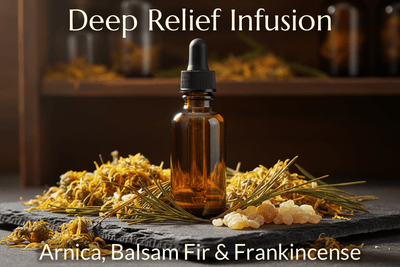
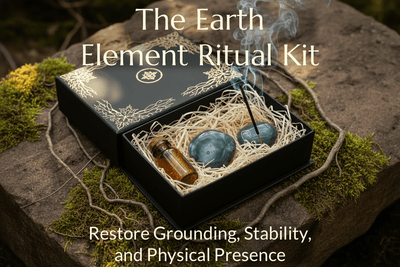
Plant preparations formulated for Earth element support tend to work through the gut, through grounding, through the slow, steady nourishment of the body's foundational systems. The arnica and balsam fir anointing oil is formulated with this axis in mind, offering topical plant support for the body's grounding and recovery. For a more complete Earth element ritual container, the Earth Element Ritual Kit brings together the sensory and somatic elements designed to support this foundational layer of the bio-spiritual system.
The gut is the body's first responder to the world, taking in nourishment and filtering what belongs and what does not. Attending to it as a spiritual and emotional organ, not just a digestive one, is one of the most grounded and practical forms of care available. The science and the traditions agree: what happens in the belly matters far beyond the belly. And the plants, held with intention, have always known how to meet us there.
If you are curious about which elemental patterns are most active in your system right now and which kinds of support might be most meaningful for this season of your life, consider exploring a personalized astrology mini-reading as a map of your current bio-spiritual terrain.